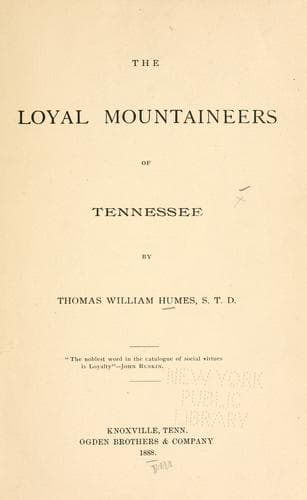
The loyal mountaineers of TennesseeHumes, Thomas William
Philosophy
The loyal mountaineers of Tennessee
Humes, Thomas William
Tennessee, East -- History -- Civil War, 1861-1865
The Civil War begun in 1861 had for years its premonitions even in
so retired a portion of the United States as East Tennessee then
was; but they were not understood by the wisest of observers. The
increased alarm among friends of the institution of slavery for its
safety, would alone have been ominous; for strong fear of losing
possessions tempts to rash and violent means of relief. There were
other signs of coming evils:--the growing desire, especially of
politicians in the South who were extremists, not only to preserve
slavery within its existing limits but to fortify its perpetuity by
extending its area; and also the widened direction of an intense and
long-cherished animosity against abolitionists, so as to include
in it all “Yankees” or “the North” in general. These sectional
sentiments were not shared by the great body of East Tennesseeans.
The large majority of them were not slave-holders. Cotton was not
grown in the region, except that a very few farmers had small
“patches” for domestic use. Even where slaves were owned, “the
peculiar institution” most often wore a homely aspect. The negroes
after a patriarchal fashion, were part of one household--the white
and black children played together without fastidious reserve, and
mutual kindly affections prevailed throughout the whole family. In
1860 the slaves were about one-tenth only of the population, and
in over one-third of the counties less than one-seventeenth. The
unlikeness of the mountainous region which is located centrally in
the Atlantic States, to that of the planting States, is positive,
and the dissimilarity in social and other conditions between their
respective inhabitants could scarcely have escaped the observation
of sagacious minds at the period named, when contemplating the
political future. It may have been not without reference to possible
coming emergencies, and to the promotion of sympathy with sectional
sentiments among these mountaineers that one of the “Southern
Commercial Conventions” which were feeders to disunion, was held in
1857 at the central town of East Tennessee. For its population then
was only something over four thousand and its commercial vitality
was small. Conspicuously apparent in the deliberations of that
Convention was a spirit of sectional zeal, which once fairly excited
and diffused, might easily upon opportunity or need be turned into a
political dissolving temper. It would be interesting to know how many
of those who were prominent in that and other “Southern Commercial
Conventions” were also not long afterwards, active in the work of
secession. Of the _lawyers_ who figured in the Knoxville mercantile
assembly was a Virginia “Hotspur.” A few years later he told the
South Carolinians who stood ready, if possible, to dissolve the
Union; “strike a blow and Virginia will go out!” The blow was struck,
Fort Sumter fell, and Virginia went out.
Public-domain text, read in full here on John Shaqi.
Reviews
Reviews
No reviews yet
Be the first to share your thoughts on this work.
Join the Discussion
Join the discussion
Sign in to leave a comment or review.
Sign InorCreate an account