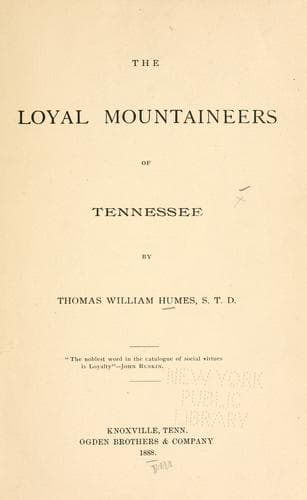
The loyal mountaineers of TennesseeHumes, Thomas William
Philosophy
The loyal mountaineers of Tennessee
Humes, Thomas William
Tennessee, East -- History -- Civil War, 1861-1865
The speech of Mr. Hopkins was lucid and logical, and reflected
much credit upon his skill and power in debate. His antagonism was
especially to the followers of Mr. Breckenridge as the authors of a
ruinous breach in the unity of the Democratic party that had so long
ruled the nation and dispensed its offices and emoluments.
Shortly before the Presidential election in the autumn of 1860,
William L. Yancey of Alabama, came to Knoxville by pre-arrangement
with resident extremists on the subject of “Southern rights,” and
spoke to a popular assembly in the open air. He labored to show that
the South did not receive justice at the hands of the North, that the
negro was never intended by the Federal Constitution and its authors
as anything more than property, that it was the interest of the white
man of the South to perpetuate slavery, because it gave the South a
political power in Congress it would not otherwise have, and also for
other reasons which he stated.
Among those who then heard him for the first time some were
disappointed that they did not find in him the able orator whom Fame
had heralded. His voice, without being disagreeable, had no special
good qualities, and was too monotonous of tone. He showed, however,
great earnestness, and now and then rose to eloquence. Evidently he
had a quick, high and imperious temper, a bold and determined will,
superior readiness and skill in debate, and the disposition to
domineer over opponents. His determination seemed to be not to heal
existing dissensions but to maintain by strife the South’s rival
powder in the nation.
His speech was not well received by many of those who heard it.
At one time being rudely interrupted by a man in the crowd, he
peremptorily silenced the intruder. Before concluding his discourse,
a note was handed to him. Having read it, he asked the writer to
come upon the platform. The note conveyed a desire to know, if, in
the event of Mr. Lincoln’s election to the Presidency, Mr. Yancey
would favor the secession of the Southern States from the Union
and forcible resistance to the Federal Government? The person so
unexpectedly elevated to the side of the orator was Mr. Maney, from
Pennsylvania, but for some years a citizen of Tennessee; endowed
with much good sense, large acquaintance with public affairs and
considerable readiness of speech. A brief colloquy ensued, in
which Mr. Yancey endeavored without success to bring Mr. Maney
into ridicule. At length it came to light that the latter was the
representative of others in the assembly whose names were signed to
the note, and which were then called aloud by Mr. Yancey, with a
request that the persons bearing them should ascend to the platform.
They complied accordingly: Rev. William G. Brownlow, Judge Samuel R.
Rodgers, O. P. Temple, John M. Fleming, and Wm. R. Rodgers, M.D.
Public-domain text, read in full here on John Shaqi.
Reviews
Reviews
No reviews yet
Be the first to share your thoughts on this work.
Join the Discussion
Join the discussion
Sign in to leave a comment or review.
Sign InorCreate an account