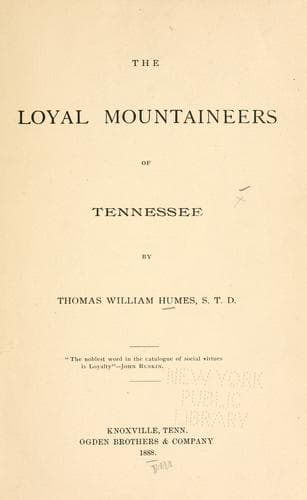
The loyal mountaineers of TennesseeHumes, Thomas William
Philosophy
The loyal mountaineers of Tennessee
Humes, Thomas William
Tennessee, East -- History -- Civil War, 1861-1865
On November 8th, an organized plan was partially carried out, by
parties of Union men, to burn the bridges of the two railways
from Knoxville, one eastward to the Virginia line and the other
westward to Chattanooga, and Dalton, Georgia. The bridges over the
Hiwassee River, Lick Creek, Greene County, and three other streams,
were destroyed. That over the Holston River at Strawberry Plains,
Jefferson County, was saved by the bravery of its watchman. These
violences created great excitement and alarm. They were the first
overt acts of resistance from among the people to the power by which
they were subjected; and were committed, no doubt, not in a spirit of
mere wanton mischief, but of war upon an enemy and for the purpose of
seriously interrupting the military communications of the Southern
Confederacy. Some political friends of the destructive workers
justified the burnings as acts of war. Others, while not dissenting
from that opinion, yet thought them inexpedient,--hurtful to public
convenience, and as a military movement, conducive to no important
practical results, because unsupported by a sufficient armed force
from outside the region.
The Confederate States authorities had apprehended an outbreak of
the slumbering discontent of the people; but they could not at first
measure the import of this particular aggression. They were therefore
liable to suppose it was the forerunner of a general uprising against
them, which would be sustained by United States soldiers from
Kentucky. The circulation of the news concerning it was quick and
general and bred universal agitation, especially among friends of
the Confederacy. Citizens gathered in towns and soldiers in camps,
to hear declamations. Everywhere, these assaults and the danger of
others, were their topics of conversation. Telegrams flew on the
wires and letters went by mail to Knoxville, increasing the alarm. A
dispatch from Charleston, Tenn., said, “Seventy-five Union soldiers
were to-day near Harrison. They had knapsacks.” And again, “Jeff
Mathes is within twelve miles of this place: has one hundred men.”
From Chattanooga: “About nine hundred men, part of them from Bradley
County, leave Clift’s in this county to-day in squads, either to
organize for operations against this place and Loudon bridge, or to
meet Union forces from Kentucky. The regiment is formidable.” A later
message said, “They have formed a camp at Bower’s, near Smith’s Cross
Roads. They may return to this place or to Loudon. They calculate to
organize one thousand men.” From Athens it was written that “some
fifteen hundred Lincoln men are under arms in Hamilton County,
ostensibly for Jamestown. Their destination is more probably Loudon
bridge.” The Major in command at Loudon, on the Tennessee River,
thirty miles west of Knoxville, wrote: “The Union feeling in this
county is exceedingly bitter, and all they want, in my opinion, to
induce a general uprising, is encouragement from the Lincoln armies.
Public-domain text, read in full here on John Shaqi.
Reviews
Reviews
No reviews yet
Be the first to share your thoughts on this work.
Elsewhere in the archive
Join the Discussion
Join the discussion
Sign in to leave a comment or review.
Sign InorCreate an account