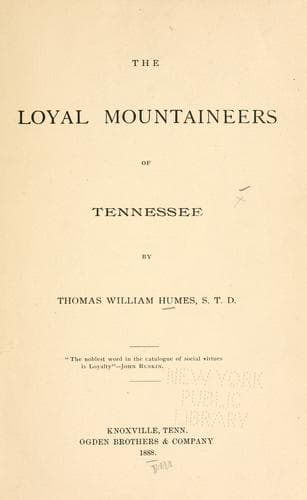
The loyal mountaineers of TennesseeHumes, Thomas William
Philosophy
The loyal mountaineers of Tennessee
Humes, Thomas William
Tennessee, East -- History -- Civil War, 1861-1865
They have a great many arms, and are actually manufacturing Union
flags to receive the refugee Tennesseeans when they return. They are
getting bold enough.” Col. Wood wrote: “The whole country is now in a
state of rebellion. A thousand men are within six miles of Strawberry
Plains and an attack is contemplated to-morrow” (November 12).
“They (the Unionists) are gathering in large force and may secure
(Washington bridge) in a day or two.” “About two miles from here in
Sevier County, already three hundred in camp, are being reinforced.”
Knoxville was at once put under martial law. The people’s houses were
arbitrarily entered day and night by military direction and their
guns and pistols demanded. Even weapons intended only for sporting
uses or for rivalry in marksmanship were included in the exaction.
In but few instances was the requisition evaded by timely secretion
of the implements. In others, they were indignantly surrendered,
carried off to the armory, and some of them never restored. No one
was allowed to depart from the town without a passport signed by a
committee of three leading secessionists from among the select few
citizens, whom Editor Sperry, of the town newspaper, compared, not
facetiously but seriously, to the few righteous men who might have
saved Sodom and Gomorrah if they could have been found. At first no
one was permitted to enter the town without a paper of that kind,
which could only be procured from the committee centrally located.
Church-going people from the vicinity were surprised on Sunday
morning to find armed men in the way who refused them ingress until
a messenger, sent by some friend known to be loyal to “the South,”
went and returned with the requisite passes. An old citizen of the
county who had a mind of his own and stoutly adhered in sentiment
to the Union, went to town without interruption, probably through
oversight of the guard, but on returning homeward, his passport
was demanded. He had none to show, for to procure such a document,
it was necessary by order of the Committee of Three to take an
oath of allegiance to the Southern Confederacy, and _that_ he had
predetermined he would not do. He was arrested, led back, arraigned
before the committee, and refusing to take the prescribed oath, he
was placed on confinement to the limits of the town until his case
should be tried before the Confederate States Commissioner. Whether
he was sent to jail, into which many were then being cast for what
was called “Union talk,” does not appear. Col. Wood, writing from
Knoxville to Adjutant General Cooper at Richmond, said: “I feel it to
be my duty to place this city under martial law, as there was a large
majority of the people sympathizing and communicating with them by
the unfrequented mountain paths, and to prevent surprises and the
destruction of public property. I need not say that great alarm is
felt by the few Southern men here. They are finding places of safety
Public-domain text, read in full here on John Shaqi.
Reviews
Reviews
No reviews yet
Be the first to share your thoughts on this work.
Elsewhere in the archive
Join the Discussion
Join the discussion
Sign in to leave a comment or review.
Sign InorCreate an account