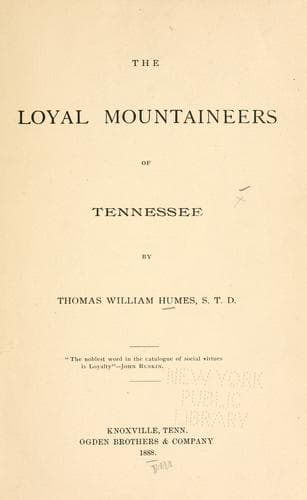
The loyal mountaineers of TennesseeHumes, Thomas William
Philosophy
The loyal mountaineers of Tennessee
Humes, Thomas William
Tennessee, East -- History -- Civil War, 1861-1865
The first English fort built in Eastern Tennessee was that of Loudon,
in 1757, so called for the Earl of Loudon, at the time Governor
of Virginia. It stood at the junction of the Tellico and Little
Tennessee rivers, now in Monroe County, and 35 miles southwest of
Knoxville. Its garrison of from two to three hundred men was, with
three exceptions, massacred by the Indians in 1760, and with it a
number of women and children.
The first permanent settlement of Anglo-Americans in the region was
made on the Watauga River, not far from the present northwestern
border of North Carolina. As early as 1748, explorers, traders and
hunters from Virginia had visited that part of the land. Thirteen
years afterwards, nineteen men were attracted to it from the same
State by the abundance of its game and were employed as sportsmen on
Clinch and Powell’s rivers for eighteen months. Another company went
towards it from North Carolina, but with the exception of the famous
Indian hunter and fighter Daniel Boone, they halted at the spot where
now is Abingdon, Virginia. Probably he had before been on the waters
of the Watauga, for a beech tree, that stands on Boone’s creek, a
tributary of that river, not far from Jonesboro, still bears this
inscription,
“_D. Boon cilled a Bar on tree in the year 1760._”
These visits were followed by others from companies of hunting
pioneers. In 1764 Boone returned to the same region from his home
on the Yadkin River, North Carolina. Another pioneer gave him a
glowing description of the country which is now Kentucky, and in
1771 he endeavored with a party of eighty persons--forty of whom
were hunters--to pass into it through Cumberland Gap. They were
waylaid and fiercely assailed by Indians and were forced to abandon
the enterprise. Some four years later it was successfully renewed,
and Boone, passing over the Clinch and Cumberland mountains from
East Tennessee, led in the establishment beyond them of a great
Commonwealth.
An eminent historian of the United States, after relating the wrongs
to which the people of North Carolina were subjected in 1770-71,
under the provincial Governor, Tryon, proceeds to tell how and where
they fled from oppression.
Public-domain text, read in full here on John Shaqi.
Reviews
Reviews
No reviews yet
Be the first to share your thoughts on this work.
Join the Discussion
Join the discussion
Sign in to leave a comment or review.
Sign InorCreate an account