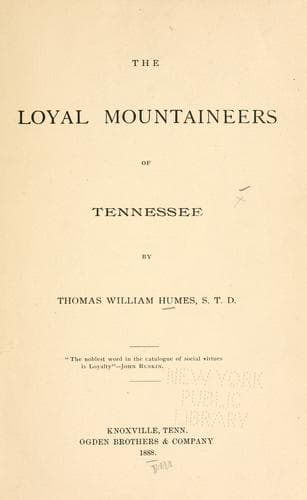
The loyal mountaineers of TennesseeHumes, Thomas William
Philosophy
The loyal mountaineers of Tennessee
Humes, Thomas William
Tennessee, East -- History -- Civil War, 1861-1865
Thereupon the District Attorney entered a _nolle-prosequi_ in the
case, and Commissioner Reynolds ordered the prisoner’s discharge. He
was instantly arrested by the military authorities, and a guard of
soldiers placed around his house day and night. For the greater part
of January and February his bodily illness continued, partly owing
no doubt to mental anxiety and troubles in the midst of enemies,
some of whom cordially hated and annoyed him. From the threatenings
that surrounded him, the apprehensions they naturally awakened,
and the vexations of his life in custody, he was delivered by the
obedience of Major Monserrat to an order by telegraph from the
Richmond Secretary of War, authorizing him “to send Brownlow out of
Tennessee.” On the third of March, the irrepressible friend of the
Union departed on his journey for another and, certainly for him a
better country, than that in which he sojourned and where he had with
singular determination and zeal waged an angry contest against odds.
Defeated at home, he left it with strong hope of the coming time when
the cause which he had deeply at heart should be there victorious
and he among the victors. His departure at the time, and in the
manner adopted, could not do otherwise than afford a sense of relief
not only to him and his friends, but also to many of his enemies. In
this latter class were some who would have been gratified had he been
sent to jail at Tuscaloosa or even to the gallows, for their passions
against him as the persistent “very head and front” of offence to
them, were kindled to white heat. And the _Register_ of the town
expressed their mind, in declaring the action of the Secretary of
War as “worse than a crime--a blunder,” and that the authorities had
“been outwitted and over-reached diplomatically” by giving a “pledge
to convey Brownlow within the Hessian lines.” Besides, they feared
that the results to the Confederate supremacy in East Tennessee of
his influence and work north of the State, would be as that journal
predicted, disastrous. It was with delays and difficulties he reached
Nashville; but after a journey of two hundred miles, requiring twelve
days, on the fifteenth of March he was delivered by his military
Confederate escort within the Federal lines at that city. There he
was heartily welcomed. Among those who greeted him were his former
East Tennessee compatriots, Andrew Johnson, then Military Governor
of the State, Horace Maynard and Connelly F. Trigg. They and he were
glad to meet again on soil of the United States where, under its
protection, they were free.
Public-domain text, read in full here on John Shaqi.
Reviews
Reviews
No reviews yet
Be the first to share your thoughts on this work.
Elsewhere in the archive
Join the Discussion
Join the discussion
Sign in to leave a comment or review.
Sign InorCreate an account