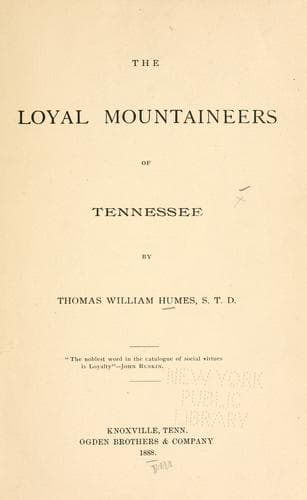
The loyal mountaineers of TennesseeHumes, Thomas William
Philosophy
The loyal mountaineers of Tennessee
Humes, Thomas William
Tennessee, East -- History -- Civil War, 1861-1865
For along time previous, less conspicuous Union men had been leaving
East Tennessee for Kentucky in smaller or larger companies. The
stream of departure was sometimes feeble, at others strong, but
always continuous. Among those who left in the earlier part of that
time was R. L. Stanford, M.D., of Sullivan County. His compulsory
expatriation resembled that of many that occurred. On his return to
East Tennessee, a Surgeon of the United States Army under General
Burnside, in September, 1863, he gave substantially a narrative of
his escape that shows the dangers to single refugees:
In 1861 his Union sentiments made him very obnoxious to many of his
neighbors. One day, returning home from visits to patients, he found
on approaching it, that he had to pass through an array of armed men
on both sides of the way. He braced up his nerves and rode between
the threatening lines with his hat off and bowing to the right and
left as he proceeded. No one of his enemies, who were also his
neighbors, was willing to take the responsibility of being the first
to fire upon him; and unhurt, he passed the gauntlet. That night
he concluded, from written warnings, that it was prudent he should
obey the order given him to leave the country. In his journey next
day to Kentucky by way of Cumberland Gap, he was accompanied by Rev.
Mr. M., a Methodist minister. At night they halted at a wayside inn,
north of the Clinch Mountains, where a few Confederate officers soon
arrived. One of them (Col. David Cummings) and Dr. Stanford being
acquaintances, they held a friendly conversation while imbibing
moderately of the drink, stronger than water, set before them by the
landlord.
“Doctor,” said the Colonel, “let me ask where you are going?”
“To tell you the truth, Colonel,” replied the Doctor, “I am going
over the mountains to buy some cattle of these Kentuckians to feed
our people.”
Public-domain text, read in full here on John Shaqi.
Reviews
Reviews
No reviews yet
Be the first to share your thoughts on this work.
Elsewhere in the archive
Join the Discussion
Join the discussion
Sign in to leave a comment or review.
Sign InorCreate an account