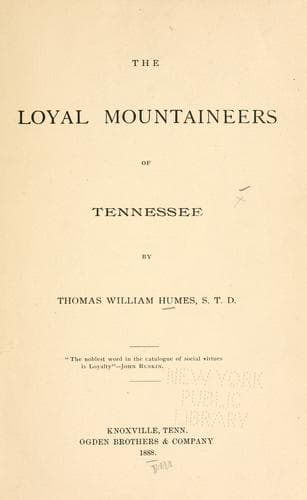
The loyal mountaineers of TennesseeHumes, Thomas William
Philosophy
The loyal mountaineers of Tennessee
Humes, Thomas William
Tennessee, East -- History -- Civil War, 1861-1865
During the colloquy Colonel C. made a significant motion to his
fellow-officer, not unobserved by the watchful refugee. The Methodist
minister being of a timid nature, had meanwhile taken a seat at the
farther end of the long front porch, with his hat pulled over his
ears to avoid recognition. Soon night fell, supper was announced, and
while it went forward Dr. Stanford, feigning illness, rose from the
table and went down the road he had just traveled until a covert of
bushes was reached. He knew that the two Confederate officers would
shortly pass by on their way from Cumberland Gap to Bean’s Station
in the great valley of East Tennessee, and from weary waiting in
concealment he was at length relieved by the sound of their horses’
feet approaching. When arrived opposite the spot where he hid, they
halted, and the owner of a cabin across the way obeyed their summons
to its door. Frightened at first by the thought that he was about to
be discovered, he soon dismissed all anxiety upon over-hearing the
conversation that ensued between Col. Cummings and the man of the
house, to whom the former gave a letter for delivery to the army
messenger who would pass by the next morning to Cumberland Gap.
At a very early hour the next day, the two refugees resumed their
journey. When they were entirely beyond hearing upon the road, the
physician said to the minister: “I think it probable that Col.
Cummings has left a letter to be sent to the Gap for our arrest
there. If the messenger carrying it overtakes us on the way, I
shall instantly shoot him.” At that early period of the war, people
generally were unaccustomed to the pre-meditated destruction of human
life, and some of them at least were slow to think of it as wearing
any complexion but that of bloody murder. It is not surprising,
therefore, that the face of the Christian minister, on hearing the
deadly intention of his companion, should have lost its usual color.
“He turned as white as a sheet.”
Arrived at Cumberland Gap without adventure, Dr. Stanford met with a
Confederate Lieutenant--his personal friend--who had joined the army
under constraint. The young man, knowing the mind of the refugee,
gave him in conversation without the camp and under the pledge of
secrecy, the word and sign by which he might pass the sentries on
the road over the Gap.[26] The minister earnestly dissuaded him
from attempting to cross the mountain, and failing in this effort,
lay sleepless throughout the night, tossed with fears of ills that
would befall them on the morrow. Breakfast over, the Doctor rode
unconcernedly on his way without any interference from the sentinels,
while the minister, abandoning the enterprise, stood and watched his
companion’s progress in ascending the mountain gap.
Public-domain text, read in full here on John Shaqi.
Reviews
Reviews
No reviews yet
Be the first to share your thoughts on this work.
Elsewhere in the archive
Join the Discussion
Join the discussion
Sign in to leave a comment or review.
Sign InorCreate an account