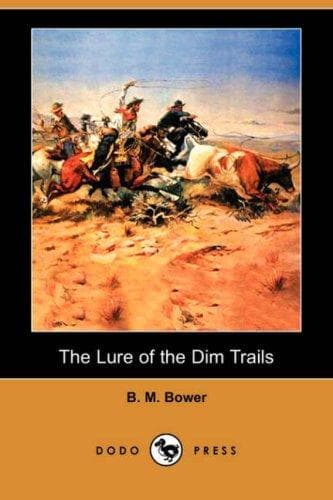
Bob told him it was the biggest mix-up he had ever seen, and Bob had
ridden the range in every State where beef grows wild. He was in the
thickest of the huddle, was Bob, working as if he did not know the
meaning of fatigue. Thurston, watching him thread his way in and out of
the restless, milling herd, only to reappear unexpectedly at the edge
with a steer just before the nose of his horse, rush it out from among
the others--wheeling, darting this way and that, as it tried to dodge
back, and always coming off victor, wondered if he could ever learn to
do it.
Being in pessimistic mood, he told himself that he would probably always
remain a greenhorn, to be borne with and coached and given boy's work to
do; all because he had been cheated of his legacy of the dim trails and
forced to grow up in a city, hedged about all his life by artificial
conditions, his conscience wedded to convention.
CHAPTER VI. THE BIG DIVIDE
The long drive was nearly over. Even Thurston's eyes brightened when
he saw, away upon the sky-line, the hills that squatted behind the home
ranch of the Lazy Eight. The past month had been one of rapid living
under new conditions, and at sight of them it seemed only a few days
since he had first glimpsed that broken line of hills and the bachelor
household in the coulee below.
As the travel-weary herd swung down the long hill into the valley of the
Milk River, stepping out briskly as they sighted the cool water in the
near distance, the past month dropped away from Thurston, and what had
gone just before came back fresh as the happenings of the morning.
There was the Stevens ranch, a scant half mile away from where the tents
already gleamed on their last camp of the long trail; the smoke from
the cook-tent telling of savory meats and puddings, the bare thought of
which made one hurry his horse.
His eyes dwelt longest, however, upon the Stevens house half hidden
among the giant cottonwoods, and he wondered if Mona would still smile
at him with that unpleasant uplift at the corner of her red mouth. He
would take care that she did not get the chance to smile at him in any
fashion, he told himself with decision.
He wondered if those train-robbers had been captured, and if the one
Park wounded was still alive. He shivered when he thought of the dead
man in the aisle, and hoped he would never witness another death;
involuntarily he glanced down at his right stirrup, half expecting to
see his boot red with human blood. It was not nice to remember that
scene, and he gave his shoulders an impatient hitch and tried to think
of something else.
Public-domain text, read in full here on John Shaqi.
Reviews
Reviews
No reviews yet
Be the first to share your thoughts on this work.
Join the Discussion
Join the discussion
Sign in to leave a comment or review.
Sign InorCreate an account