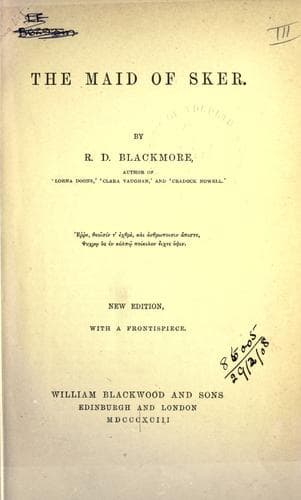
The Maid of SkerBlackmore, R. D. (Richard Doddridge)
General
The Maid of Sker
Blackmore, R. D. (Richard Doddridge)
Foundlings -- Fiction; Romance fiction; Wales -- Fiction
However, this would never do. I felt myself strongly under orders; and
but for this paramount sense of duty, never could I have done the things
modestly mentioned as of yore; and those of hereafter tenfold as fine,
such as no modesty dare suppress. So, when I had explained to him
exactly how I stood about it, he did not refuse to fill his pipe with a
bit of my choice tobacco, and to come away from all idle folk, to a
place in the shelter of a rick, where he was sure to hear the hoofs of
his master's horse returning. I sate with him thus, and we got on well;
and as he was going to marry soon the daughter of a publican, who had as
good as fifty pounds, and nothing that could be set on fire, and lived
fifty miles away almost, he did not mind telling me all the truth,
because he saw that I could keep it; and at his age he could not enter
into the spirit of being kicked so. I told him I should like to see a
man kick me! But he said that I might come to it.
This was a very superior man, and I durst not contradict him; and having
arranged so to settle in life, how could he hope to tell any more lies?
For I have always found all men grow pugnaciously truthful, so to put
it, for a month almost before wedlock; while the women are doing the
opposite. However, not to go far into that, what he told me was much as
follows:--
Parson Chowne, in early life, before his mind was put into shape for
anything but to please itself, had been dreadfully vexed and thwarted.
Every matter had gone amiss, directly he was concerned in it; his
guardians had cheated him, so had his step-mother, so had his favourite
uncle, and of course so had his lawyers done. In the thick of that
bitterness, what did his sweetheart do but throw him over. She took a
great scare of his strange black eyes, when she found that his money was
doubtful. This was instinct, no doubt, on her part, and may have been a
great saving for her; but to him it was terrible loss. His faith was
already astray a little; but a dear wife might have brought it back, or
at any rate made him think so. And he was not of the nature which gropes
after the bottom of everything, like a twisting augur. Having a prospect
of good estates, he was sent to London to learn the law, after finishing
at Oxford, not that he might practise it, but to introduce a new element
to the county magistrates, when he should mount the bench among them.
Here he got rogued, as was only natural, and a great part of his land
fell from him, and therefore he took to the clerical line; and being of
a stern and decided nature, he married three wives, one after the other,
and thus got a good deal of property. It was said, of course, as it
always is of any man thrice a widower, that he or his manner had killed
his wives; a charge which should never be made without strong evidence
in support of it. At any rate there had been no children; and different
opinions were entertained whether this were the cause or effect of the
Public-domain text, read in full here on John Shaqi.
Reviews
Reviews
No reviews yet
Be the first to share your thoughts on this work.
Elsewhere in the archive
Join the Discussion
Join the discussion
Sign in to leave a comment or review.
Sign InorCreate an account