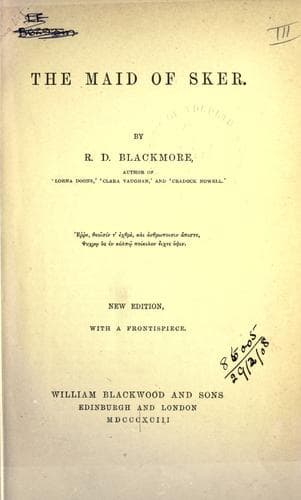
The Maid of SkerBlackmore, R. D. (Richard Doddridge)
General
The Maid of Sker
Blackmore, R. D. (Richard Doddridge)
Foundlings -- Fiction; Romance fiction; Wales -- Fiction
Parson's dislike and contempt of little ones. Moreover, as women usually
are of a tougher staple than men can be, Chowne's successive liberation
from three wives had added greatly to his fame for witchcraft, such as
first accrued from his commanding style, nocturnal habits, method of
quenching other people, and collection of pots and kettles. The
head-groom told me, with a knowing wink, that in his opinion the Parson
was now looking after wife No. 4, for he never had known him come out so
smart with silver heels and crested head-piece, and even the mark of the
saddle must not show upon his breeches. This was a sure sign, he
thought, that there was a young lady in the wind, possessing both money
and good looks, such as Chowne was entitled to, and always had insisted
on. Upon that point I could have thrown some light (if prudence had
permitted it), or at least I had some shrewd suspicions, after what
happened beside the river; however, I said nothing. But I asked him what
in his opinion first had soured the young man Chowne against the whole
of the world so sadly, as he seemed to retain it now. And he answered me
that he could not tell, inasmuch as the cause which he had heard given
seemed to him to be most unlikely, according to all that he saw of the
man. Nevertheless I bade him tell it, being an older man than he was,
and therefore more able to enter into what young folk call
"inconsistencies." And so he told me that it was this. Chowne, while
still a young boy, had loved, with all the force of his heart, a boy a
few years younger than himself, a cousin of his own, but not with
prospects such as he had. And this boy had been killed at school, and
the matter hushed up comfortably among all high authorities. But Stoyle
Chowne had made a vow to discover and hunt it out to the uttermost, and
sooner or later to have revenge. But when his own wrongs fell upon him,
doubtless he had forgotten it. I said that I did not believe he had done
so, or ever would, to the uttermost.
Then I asked about Parson Jack, and heard pretty much what I expected.
That he was a well-meaning man enough, although without much sense of
right or wrong, until his evil star led him into Parson Chowne's
society. But still he had instincts now and then, such as a horse has,
of the right road; and an old woman of his church declared that he did
feel his own sermons, and if let alone, and listened to, might come to
act up to them. I asked whether Parson Chowne might do the like, but was
told that he never preached any.
We were talking thus, and I had quite agreed to his desire of my company
for supper-time, when the sound of a horse upon stony ground, tearing
along at a dangerous speed, quite broke up our conference. The groom, at
the sound of it, damped out his pipe, and signified to me to do the
same.
Public-domain text, read in full here on John Shaqi.
Reviews
Reviews
No reviews yet
Be the first to share your thoughts on this work.
Elsewhere in the archive
Join the Discussion
Join the discussion
Sign in to leave a comment or review.
Sign InorCreate an account