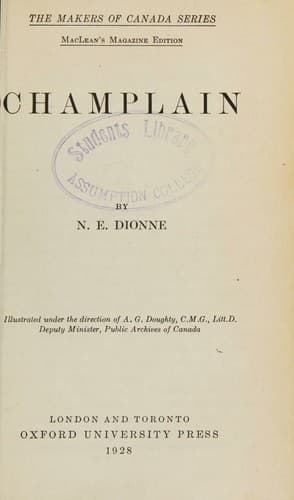
The Makers of Canada: ChamplainDionne, N.-E. (Narcisse-Eutrope)
History
The Makers of Canada: Champlain
Dionne, N.-E. (Narcisse-Eutrope)
Canada -- History -- To 1763 (New France); Champlain, Samuel de, 1574-1635
Champlain left no posterity. His wife spent only four years in Canada,
after which she resided continually in Paris. During her residence in
New France, she studied the Algonquin language, and instructed the young
Indians in catechism, and in this manner she won the friendship of the
native tribes. It was the fashion of the time for a lady of quality to
wear at her girdle a small mirror, and the youthful Helene observed the
custom. The savages, who were delighted to be in her company, were oft
time astonished to see their own image reflected on the crystalline
surface of this mirror, and said, with their native simplicity: "A lady
so handsome, who cures our diseases, and loves us to so great an extent
as to bear our image near her breast, must be superior to a human
being." They, therefore, had a kind of veneration for her, and they
would have offered their homage to her instead of to the Deity of whom
they had only an imperfect knowledge.
The Indians were Madame Champlain's special care, but she was respected
by the French as well. We do not know very much about her social
intercourse with the different families of Quebec, but it is not
probable that she ignored Madame Hebert or her family, as Faillon seems
to believe. Her own distinction and the position of her husband would,
no doubt, render her particular in the choice of friends, but we can
scarcely believe that she would completely ignore Madame Couillard, who
was of her own age. How was it that she consented to live alone in
Quebec during the long absence of her husband?
After her return to Paris in 1624, Madame Champlain lived alone, and
became more and more detached from the world, till she asked her husband
to allow her to enter an Ursuline convent. Champlain, fearing that this
desire might arise rather from caprice than a vocation for the life of
the cloister, thought it advisable to refuse her request, and he bade
her a last adieu in 1633. After Champlain's death, Father Le Jeune
informed her that she was now free to follow the dictates of her heart.
Public-domain text, read in full here on John Shaqi.
Reviews
Reviews
No reviews yet
Be the first to share your thoughts on this work.
Elsewhere in the archive
Join the Discussion
Join the discussion
Sign in to leave a comment or review.
Sign InorCreate an account