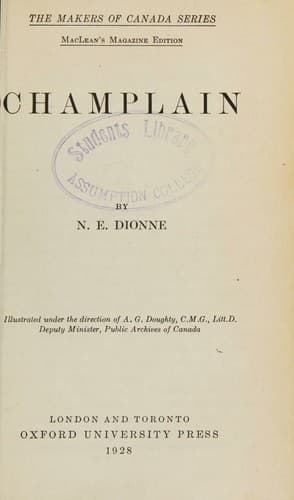
The Makers of Canada: ChamplainDionne, N.-E. (Narcisse-Eutrope)
History
The Makers of Canada: Champlain
Dionne, N.-E. (Narcisse-Eutrope)
Canada -- History -- To 1763 (New France); Champlain, Samuel de, 1574-1635
According to the marriage settlement, Champlain was obliged to leave to
his wife, if she were still living, all his possessions. By his last
will, however, he left all his property to the church. Champlain had no
desire to injure his wife by this act; on the contrary, he knew that her
piety was great, and that she would probably applaud the course he had
taken, which was owing to his extraordinary devotion to Notre Dame de la
Recouvrance, the church which he had built and loved. Madame Champlain,
in fact, made no opposition, and the will was confirmed on July 11th,
1637. The will, however, was contested by Marie Camaret, a first cousin
of Champlain, and wife of Jacques Hersault, comptroller of customs at La
Rochelle, and a famous trial was the result. The will was contested on
two grounds: (1.) That the will was contrary to the marriage settlement,
and therefore ought to be annulled; (2.) That the will was made by
foreign hands, as it was difficult to suppose that Champlain had chosen
the Virgin Mary as his heir.
These were the contentions of Master Boileau. The attorney-general
Bignon easily refuted the second allegation by proving that Madame
Champlain had recognized the signature of her husband, and had stated
that the expression and style were his. The terms of this bequest to the
Virgin were quite natural to a man of Champlain's character, "When we
know," said the attorney, "that he frequently made use of Christian
expressions in his general conversation."
Although the authenticity of the will was proved, the attorney-general
argued that it ought to be set aside in face of the deed of settlement.
The court upheld this view, and the property of Champlain, with the
exception of the sum of nine hundred livres, derived from the sale of
his chattels, returned to his natural heirs.
This trial and other affairs prevented Madame Champlain from carrying
out her resolution, and it was not until November 7th, 1645, that she
entered the monastery of St. Ursula at Paris. She first entered the
institution as a benefactress, and soon after became a novice under the
name of Helene de St. Augustin. There seems to have been some
difficulties with regard to her profession as a nun, and she therefore
resolved to found an Ursuline monastery at Meaux. Bishop Seguier granted
the necessary permission to found the monastery, and also for her to
take with her three nuns and a lay sister. Helene de St. Augustin left
Paris for Meaux on March 17th, 1648, and made her profession five months
after. As a preparation for this solemn act, she made a public
confession in the presence of the community. She also recited her
faults, kneeling, and wearing a cord about her neck, and bearing a
lighted taper in her hands. Mere Helene de St. Augustin lived only six
years in her convent at Meaux, and died on December 20th, 1654, at the
age of fifty years, leaving the memory of a saintly life.
Public-domain text, read in full here on John Shaqi.
Reviews
Reviews
No reviews yet
Be the first to share your thoughts on this work.
Elsewhere in the archive
Join the Discussion
Join the discussion
Sign in to leave a comment or review.
Sign InorCreate an account