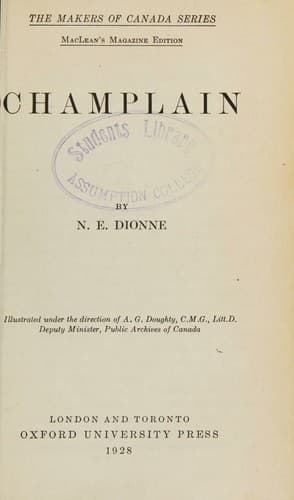
The Makers of Canada: ChamplainDionne, N.-E. (Narcisse-Eutrope)
History
The Makers of Canada: Champlain
Dionne, N.-E. (Narcisse-Eutrope)
Canada -- History -- To 1763 (New France); Champlain, Samuel de, 1574-1635
If we study the history of the mercantile companies from the years 1608
to 1627, we find on the one hand, a body of men absorbed by one idea,
that of growing rich, and on the other hand, a man, anxious, it is true,
to look after the material interests of the merchants and of the people,
but hand in hand with this the desire to extend the dominion of his
sovereign. Here was a vast country, capable of producing great wealth,
and struggling for its possession was a body of avaricious men, while
valiantly guarding its infancy, we find a single champion, the heroic
Champlain. Champlain watched over the new settlement with the tender
solicitude of a parent carefully protecting his offspring from danger,
and ready to sacrifice his life to save it from disaster. In small
vessels of sixty or eighty tons, Champlain had repeatedly exposed his
life to danger in crossing the ocean. His health had also been exposed
during the days and nights spent in the open forests, or when passing
on the dangerous rivers in his efforts to explore new territory. He was
also constantly at the mercy of the Indians, whose treachery was
proverbial. Under all these dangers and through all these conditions,
Champlain's conduct was exemplary. He was charitable as a missionary
towards these poor children of the woods. When threatened with hunger or
malady, he relieved their wants and took care of the young children,
some of whom he adopted. Others again he placed in French families,
hoping that sooner or later they would be baptized into the fold of
Christ's flock. In his intercourse with the chiefs, Champlain took
occasion to explain to them the rudiments of the Christian faith, hoping
thereby to pave the way for the work of the missionaries. Whenever he
found any children that seemed more intelligent than usual, he sent them
to France, where they could be instructed, and either enter a convent or
take service in some good family. And who can tell whether some of these
children did not afterwards become missionaries to their own country?
Champlain's prudence in his dealings with the savages was not less
remarkable than his charity. This conduct gave him an influence over the
Indians that no other Frenchman was able to obtain. The Indian tribes
regarded Champlain as a father, but their love was mingled with a
reverential fear, and every word and action was of deep significance to
them. They had faith in Champlain, which after all was not unusual, for
he had never deceived them. Though they were barbarous and uncouth, and
generally untruthful, they could distinguish the false from the true
from the lips of a Frenchman. Being given to dissimulation themselves,
they could appreciate sincerity in others.
Public-domain text, read in full here on John Shaqi.
Reviews
Reviews
No reviews yet
Be the first to share your thoughts on this work.
Elsewhere in the archive
Join the Discussion
Join the discussion
Sign in to leave a comment or review.
Sign InorCreate an account