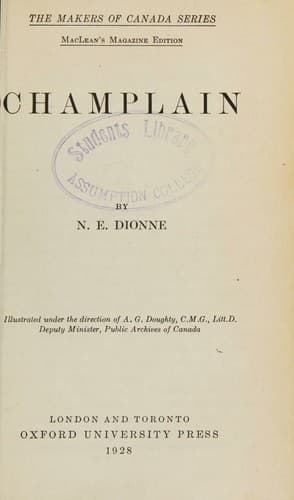
The Makers of Canada: ChamplainDionne, N.-E. (Narcisse-Eutrope)
History
The Makers of Canada: Champlain
Dionne, N.-E. (Narcisse-Eutrope)
Canada -- History -- To 1763 (New France); Champlain, Samuel de, 1574-1635
Some writers have questioned Champlain's prudence touching the alliance
which he made with some Indians for the purpose of fighting the
aggressive Iroquois. We have already shown that if Champlain desired to
maintain his settlement at Quebec, such an alliance was not only
prudent, but essential. The Hurons and allied tribes, it is true, were
barbarous, though not to so great an extent as the Iroquois, but they
had the same vices and were as perfidious. The least discontent or whim
would have been sufficient for the whole band to have swept the fort
away. By making an alliance with them, and promising to assist them
against their inveterate foes, it became to their advantage to support
Champlain, and thus to render his people secure against attack. Moreover
the numerical strength of the settlers in the early days was not
sufficient for Champlain to have imposed terms by force of arms, and as
it was necessary for his people to trade with the Indians, he could not
have done better, under the circumstances, than to form this alliance,
which insured business relations and protection for his countrymen.
This alliance was undoubtedly made at a sacrifice to Champlain, and he
had to suffer many humiliations and privations thereby. We cannot
imagine that he found any pleasure in going to war with a lot of
savages, or in fighting against a ferocious band, with whom neither he
nor his people had any quarrel. It is certain that Champlain did not
encourage them in their wars, and he was careful not to put any weapons
into their hands. The same amount of prudence was not exercised by those
who came after the French and endeavoured to colonize New England and
New Netherland.
Champlain's policy was one of conciliation. He desired peace, harmony
and charity above all things. As a respectful and obedient child of his
mother, the Catholic Church, he was very anxious that her teachings and
advice should be observed by those who were placed under his authority.
Although in his early life he had followed the career of a soldier,
still he regarded the profession of arms as useful only to put into
question the ancient axiom, _Si vis pacem, para bellum_. Wars and
quarrels had no attraction for Champlain, and he always preferred a
friendly arrangement of any difficulty. He was a lover of peace, rather
than of bloodshed, and the kindly nature of his disposition prevented
him adopting vigorous measures.
Public-domain text, read in full here on John Shaqi.
Reviews
Reviews
No reviews yet
Be the first to share your thoughts on this work.
Elsewhere in the archive
Join the Discussion
Join the discussion
Sign in to leave a comment or review.
Sign InorCreate an account