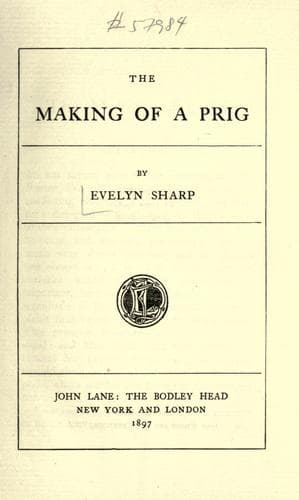
England -- Social life and customs -- 19th century -- Fiction
The light flared up, and made a bright semicircle in the gloom that
was fast closing up round the shop. The customer who was inside
concluded his purchase, and came out just as Ted was strolling off.
Apparently they did not see each other, and the fog soon swallowed up
the retreating form; but Katharine turned round at this moment from
the book she was examining, and met the stranger face to face.
"Ah," he said, quietly; "at last!"
"Yes," she repeated; "at last!"
It did not strike her until afterwards that it was not at all the mode
of address with which she would have greeted him had she been more
prepared; but at the time it came quite naturally to her lips. He
still held her hand as he went on speaking.
"And Ted? Where have you sent him? Will he be long?"
She resented the implication in his words.
"I have not sent him anywhere. He has gone to fetch my father from the
Museum; they will be back directly. Do you mean to say you recognised
Ted in that instant?"
"Why, surely! Did you not recognise me, although I was standing back
there in the shadow?"
"Of course I didn't," cried Katharine hotly, as she pulled away her
hand. "I never saw you until you came out into the light. I should
have stopped Ted if I had."
"Oh, to be sure; pardon my mistake. Of course you would have detained
Ted in that case." And he smiled as though he were faintly amused at
something.
She had noticed his glad look of recognition, and she hated him for
it. What right had he to be glad to see her? And now that he was
laughing at her and making insinuations about Ted, true insinuations
moreover, she hated him still more for his acuteness.
"So you are back in town?" he was saying, with what appeared to be
meant for a kindly interest. "I am not surprised, though. I always
knew you would have to come back."
"What do you mean?" she asked, feeling more annoyed than ever. It was
so like him to know everything about her without being told, and then
to put a complexion upon it that he gave her no opportunity of
contradicting. "We came up, daddy and I, because Ted was ill; and we
are going back again on Wednesday."
"Really? My mistake again. It is difficult to imagine Ted except in
the complete enjoyment of his health. Not seriously ill, I hope?"
"Oh, no," she said, with an uncomfortable conviction that she was
being made to expose herself in all her weakness; "but there was no
one to nurse him, so I came. He is all right now."
"So I should judge from the brief glimpse I had of him just now. Lucky
fellow, Ted! He looked very jolly, I thought; no doubt he has good
cause for his happiness. You are looking well too, if I may say so. It
is very delightful to be young, is it not?"
She felt a wild rage against him for detecting the situation so
absolutely, and for making it merely a subject for his raillery. She
did not know how she would have wished him to take it, but she hated
him all the same for so calmly accepting it.
Public-domain text, read in full here on John Shaqi.
Reviews
Reviews
No reviews yet
Be the first to share your thoughts on this work.
Elsewhere in the archive
Join the Discussion
Join the discussion
Sign in to leave a comment or review.
Sign InorCreate an account