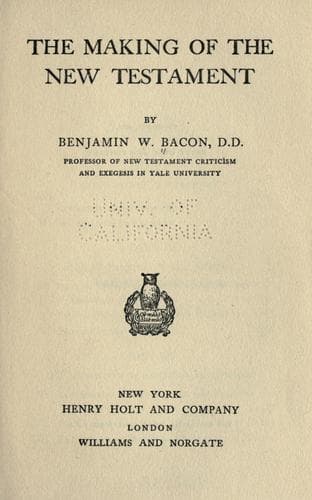
The Making of the New TestamentBacon, Benjamin Wisner
Religion
The Making of the New Testament
Bacon, Benjamin Wisner
Bible. New Testament -- Introductions
life and teaching of Jesus, immeasurably superior to the remote and
indirect tradition of the present Synoptic sources. But as a matter of
real fact those who maintain the Johannine authorship do not venture to
assert any such historical superiority. On the contrary they consider
the Synoptic tradition not only historically superior to "John," as
respects both sayings and course of events, but they are apt to
attribute to this Galilean apostle an extreme of Philonic abstraction,
so that he even prefers deliberate "fiction" to fact. Thus the reasoning
employed to defend the tradition destroys the only factor which could
give it value.
On the other hand it is possible to disregard these secondary disputes,
which aim only to increase or diminish the authority of the writings by
asserting or denying that they were written by the Apostle John, and to
approach the interpretation of them on the basis only of what is really
known, accredited both by ancient tradition and by modern criticism. On
this basis we can safely affirm that they originated in Ephesus early in
the second century, 'spiritualizing' what we have designated 'apostolic'
teaching, while at the same time strongly reacting against Doketic and
Antinomian heresy. By such a procedure we shall be employing modern
critical methods to the highest practical advantage in the interest of
genuinely historical interpretation.
Even those who find minute distinctions in style and point of view
between the Epistles and Gospel of John will admit that all four
documents emanate from the same period, situation, and circumstances,
and represent the same school of thought. We shall make no serious
mistake, then, if we treat them as written by the same individual, and
even as intended to accompany one another. We shall have the example of
so high an authority as Lightfoot, who considered 1st John an Epilogue
composed to accompany the Gospel in place of the present Epilogue (John
xxi.). Moreover the distinctions in the ancient treatment of 1st John
and the two smaller Epistles are all subsequent to the attribution of
the Gospel and First Epistle to the Apostle, and a consequence of it.
For 1st John and the Gospel had always been inseparable, and having no
name attached could easily be treated as the Apostle's. But 2nd and 3rd
John distinctly declare themselves written by an "Elder"; and in the
days when men still appreciated the distinction between an Elder and an
Apostle it was felt to be so serious a difficulty that 2nd and 3rd John
were put in the class of "disputed" writings. In reality 1st John and
the Gospel are just as certainly the work of an "Elder" as 2nd John and
3rd John, though no declaration to that effect is made. Moreover 1st
John and the Gospel may safely be treated as from the same author; for
such minute differences as exist in style and point of view can be fully
accounted for by the processes of revision the Gospel has demonstrably
undergone.
Public-domain text, read in full here on John Shaqi.
Reviews
Reviews
No reviews yet
Be the first to share your thoughts on this work.
Elsewhere in the archive
Join the Discussion
Join the discussion
Sign in to leave a comment or review.
Sign InorCreate an account