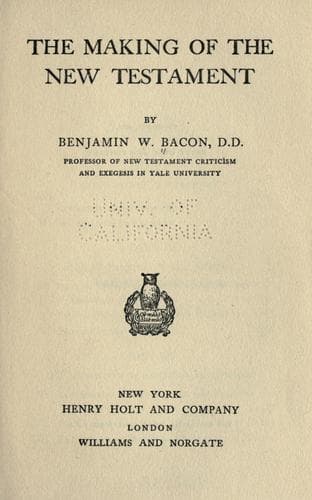
The Making of the New TestamentBacon, Benjamin Wisner
Religion
The Making of the New Testament
Bacon, Benjamin Wisner
Bible. New Testament -- Introductions
This is more reasonable than to imagine two authors so
extraordinarily similar to one another and extraordinarily different
from everybody else.
"The Elder" does not give his name, and it is hopeless for us to try to
guess it, though it was of course well known to his "beloved" friend
"Gaius," to whom the third letter (the outside envelope) was addressed.
We have simply three epistles, one (3rd John) personal, to the aforesaid
Gaius, who is to serve as the writer's intermediary with "the church,"
because Diotrephes, its bishop, violently opposes him. Another (2nd
John) is addressed to a particular church ("the elect lady and her
children"), in all probability the church of Diotrephes and Gaius. It
may be the letter referred to in 3rd John 9. The third (1st John) is
entirely general, not even so much modified from the type of the homily
toward that of the epistle as Hebrews or James; for it has neither
superscription nor epistolary close. And yet it is, and speaks of itself
(i. 4; ii. 1, 7, 9, 12-14, etc.) as a literary product. It is not
impossible that this group of 'epistles,' one individual, one to a
particular church, one general, was composed after the plan of the
similar group addressed by Paul to churches of this same region,
Philemon, Colossians, and the more general epistle known to us as
Ephesians. They may have been intended to accompany and introduce the
Gospel written by the same author, just as the prophecies of Rev.
iv.-xxi. are introduced by the 'epistles' of Rev. i.-iii., or as
Luke-Acts is sent under enclosure to Theophilus for publication under
his patronage. At all events, be the connection with the Gospel closer
or more remote, to learn anything really reliable about the writer and
his purpose and environment we must begin with his own references to
them, first in the letter to Gaius, then in that to "the elect lady and
her children," then in his 'word of exhortation' to young and old, of
1st John. Thus we shall gain a historical approach finally to that
treatise on the manifestation of God in Christ which has won him the
title since antiquity of the 'theologian.'
Public-domain text, read in full here on John Shaqi.
Reviews
Reviews
No reviews yet
Be the first to share your thoughts on this work.
Elsewhere in the archive
Join the Discussion
Join the discussion
Sign in to leave a comment or review.
Sign InorCreate an account