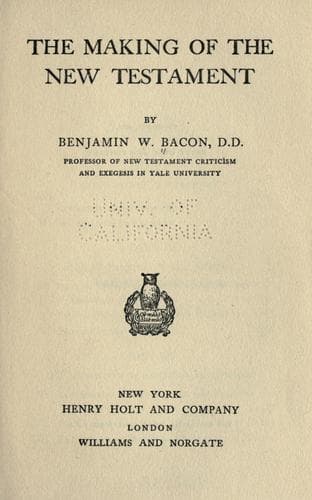
The Making of the New TestamentBacon, Benjamin Wisner
Religion
The Making of the New Testament
Bacon, Benjamin Wisner
Bible. New Testament -- Introductions
All this, and much more which we need not cite, makes hardly the
pretence of being history. It is frankly theology, or rather
apologetics. We have as a framework the general outline of Mark, a
Galilean and a Judæan ministry (chh. i.-xii.; xiii.-xx.), with traces of
a Perean journey (vii. 1 ff.). This scheme, however, is broken through
by another based on the Mosaic festal system, Jesus showing in each case
as he visits Jerusalem, the higher symbolism of the ceremonial (ii. 13
ff. Passover; v. 1 ff. Pentecost; vii. 1 ff. Tabernacles; x. 22
ff. Dedication; xii. 1 ff. Passover). There is in chh. i.-iv. a
'teaching of baptisms' and of endowment with the Spirit corresponding
roughly to Mark i. 1-45. There is in ch. v. a teaching of the authority
of Jesus against Moses and the Law, corresponding to Mark ii. 1--iii. 6.
There is a teaching of the 'breaking of bread' corresponding to Mark vi.
30--viii. 26 in John vi., though this last has been related not merely to
the brotherhood banquet ('love-feast') as in Mark, but anticipates and
takes the place of the teaching as to the Eucharist (_cf._ John vi.
52-59 with John xiii.). There is a Commission of the Twelve like Matt.
x. 16-42, though placed (with Luke xxii. 35-38) as a second sending on
the night of betrayal (xiii. 31--xviii. 26). There is dependence on
Petrine Story, and to some extent on Matthæan Sayings. In particular
John xii. 1-7 combines the data of Mark xiv. 3-9 with those of Luke vii.
36-50; x. 38-42 in a curious compound, making it certain that the
evangelist employed these two--and Matthew as well, if xii. 8 be
genuine (it is not found in the ancient Syriac). Yet our Synoptic
Gospels are not the only sources, and the material borrowed is handled
with sovereign superiority. In short, as even the church fathers
recognized, this Gospel is of a new type. It does aim to "supplement"
the others, as they recognized; but not as one narrative may piece out
and complete another. Rather as the unseen and spiritual supplements the
external and visible. This Gospel uses the established forms of
miracle-story and saying; but it transforms the one into symbol, the
other into dialogue and allegory. Then by use of this material
(supplemented from unknown, perhaps oral, sources) it constructs a
series of interpretations of the person and work of the God-man.
Public-domain text, read in full here on John Shaqi.
Reviews
Reviews
No reviews yet
Be the first to share your thoughts on this work.
Elsewhere in the archive
Join the Discussion
Join the discussion
Sign in to leave a comment or review.
Sign InorCreate an account