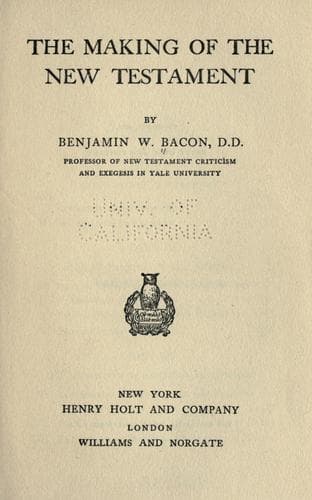
The Making of the New TestamentBacon, Benjamin Wisner
Religion
The Making of the New Testament
Bacon, Benjamin Wisner
Bible. New Testament -- Introductions
Of one peculiarly distinctive feature we have still to speak. Where the
reader has special need of an interpreter to attest and interpret a
specially vital fact, such as the scenes of the night of the betrayal,
or the reality of Jesus' propitiatory death (denied by the Doketists),
or the beginning of the resurrection faith, Peter's testimony is
supplemented and transcended by that of a hitherto unknown figure, who
anticipates all that Peter only slowly attains. This is the mysterious,
unnamed "disciple whom Jesus loved" (xiii. 23 ff.; xviii. 15 f.;
xix. 25-37; xx. 1-10; _cf._ Gal. xx. 20), a Paul present in the spirit,
to see things with the eye of spiritual insight. There is no
transfiguration-scene and no prayer of Gethsemane in this
Gospel--Transfiguration is needless where the glory shines uninterrupted
through the whole career. Prayer itself is impossible where oneness with
the God-head makes difference of thought or purpose inconceivable. Hence
the prayers of Jesus are often only "for the sake of those that stand
by" (xi. 41 f.). The same is true of the Voice from heaven at the
scene which takes the place of Transfiguration and Gethsemane in one
(xii. 27-33). Jesus will not ask for deliverance from that hour, because
he had sought it from the beginning. His prayer is "Father, glorify thy
name." The Voice, which some take to be an angel speaking to him (_cf._
Luke ix. 35; xxii. 43) is for the sake of the bystanders. The Voice at
his baptism likewise is not addressed to him (the incarnate Logos does
not need a revelation of his own identity) but to the Baptist.
So again and again Synoptic scenes are retouched and new scenes are
added in a way to present a consistent picture of the "tabernacling" of
the pre-existent Son of God in human flesh. As we review the whole, and
ask ourselves, What is the occasion of this strange new presentation of
the evangelic message? we begin to realize how indispensable is the key
which the evangelist has himself hung before the door. Many and complex
are the problems which confront us as we move through this heaped-up
tangle of anecdote, dialogue, and allegory. There is room for the
keenest scrutiny of criticism to determine, if possible, when, and how,
and from what sources these meditations were put together. But nothing
that critical insight, analysis, and comparison can furnish avails so
much to throw real light upon the work as what the evangelist himself
has done, by setting forth in a prologue (i. 1-18) the fundamental
principles of his conception.
Public-domain text, read in full here on John Shaqi.
Reviews
Reviews
No reviews yet
Be the first to share your thoughts on this work.
Elsewhere in the archive
Join the Discussion
Join the discussion
Sign in to leave a comment or review.
Sign InorCreate an account