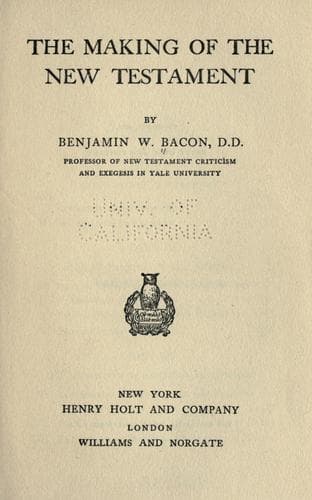
The Making of the New TestamentBacon, Benjamin Wisner
Religion
The Making of the New Testament
Bacon, Benjamin Wisner
Bible. New Testament -- Introductions
It is true that the function of "tending the flock of God" (_cf._ 1st
Pet. v. 2) committed to Peter in xxi. 15-19 is a more special one than
the apostolate conferred on all in xx. 21-23; but the Epilogue has
previously (xxi. 1-14) given to Peter a special and commanding part in
the apostolate (extension of the gospel to the world). No one will
question that in such a writer as the Fourth evangelist (and if anything
still more the writer of the Epilogue) narratives of miracle are
intended to have a symbolical sense. Nor will it be denied that the
miraculous draft of fishes, which in Luke v. 1-11 attends the original
vocation of "Simon,"[33] is here applied to the work the twelve are to
accomplish in the now opening future as "fishers of men." The
particularization of the number of the fishes, and the statement that
the peril of the rending of the net (_cf._ Luke v. 6) was happily
avoided, are, of course, also intended to convey a symbolical sense,
which Jerome makes still easier to grasp by informing us that 153 was
taken by naturalists of the time to be the full number of all species of
fish. John xxi. 1-14 is therefore a primitive story of the appearance
of Jesus after his resurrection "to Peter and them that were with him,"
in Galilee (not in Jerusalem as in John i.-xx. and Luke), having a
relation to Luke v. 1-11, and probably also to Matt. xiv. 28-33 (_cf._
John xxi. 7). It is also nearly akin to the fragment at the end of the
_Gospel of Peter_. It symbolizes the work of the apostolic mission under
the figure of the fishing of men (_cf._ Mark i. 17; Matt. xiii. 47-50),
and gives to Peter the leading part. In fact Peter not only comes to the
Lord in advance of all the rest, and alone maintains with him something
like the intimate relations of the past, but performs after his private
interview with Jesus the gigantic feat of bringing unaided to land the
entire miraculous catch. The great and various multitude, which all
working in common had enclosed in the net, but had not been able to lift
into the boat, Peter, at Jesus' word, brought safely home. The writer
who so employs the already conventionalized symbols of ecclesiastical
imagery, surely had no mean idea of the apostleship of Peter. In at
least as high degree as the author of Acts he conceives of Peter as
commissioned in a special sense to be the great director and leader of
all missionary activity, to Gentiles as well as Jews (Acts xv. 7), and
to have been the saviour of the unity of the church in the hour of its
threatened disruption. When in addition he is invested by Jesus with the
insignia and office of chief under-shepherd of the flock of God, the
stain of his threefold denial wiped out by a threefold opportunity to
prove his special love by special service, and the ignominy of his
previous failure to "follow" (xiii. 36-38) atoned for by the promise
that in old age he shall have opportunity to follow Jesus in martyrdom
(xxi.
Public-domain text, read in full here on John Shaqi.
Reviews
Reviews
No reviews yet
Be the first to share your thoughts on this work.
Elsewhere in the archive
Join the Discussion
Join the discussion
Sign in to leave a comment or review.
Sign InorCreate an account