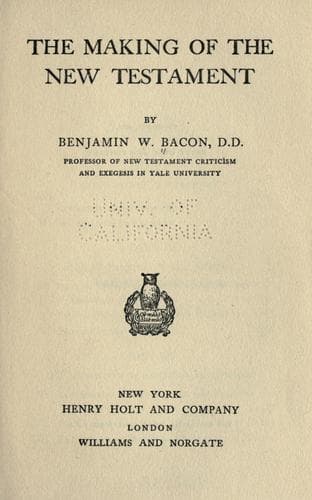
The Making of the New TestamentBacon, Benjamin Wisner
Religion
The Making of the New Testament
Bacon, Benjamin Wisner
Bible. New Testament -- Introductions
18 f.), there remains nothing that the most exacting friend of
'catholic' apostolicity could demand in the way of tribute to its great
representative.
Footnote 33: The addition in ver. 10_a_ and the plural "they" in
ver. 11, are mere editorial adaptations of the story to Mark i.
16-20.
And yet the main object of the Epilogue has not yet been touched. It was
not written, we may be sure, merely to glorify Peter; though it is, of
course, insupposable that the Gospel in its primitive form simply left
Peter in the attitude of a renegade after xviii. 27, to reappear quite
as if nothing had happened in xx. 1 ff.[34] It pays its tribute to
Peter as chief witness to the resurrection, chief apostle, chief saviour
of the unity of the church, chief under-shepherd of the flock of God, in
the interest of that catholic apostolic unity which all churchmen were
so earnestly labouring to achieve in the writer's time, and for which
the name of Peter was increasingly significant. But the chief object of
the Epilogue is something else. It was written primarily to commend and
find room for another authority, the authority of the Gospel to which
it is appended, and which repeatedly sets over against Peter a
mysterious unnamed figure, who always sees when Peter is blind, believes
when Peter is unbelieving, is faithful when Peter and all the rest have
fled in cowardly desertion. The object of the Epilogue is to find room
alongside the growing and salutary authority of Peter for the authority
and message of "the disciple whom Jesus loved." Its purpose appears in
its conclusion, "This (the disciple whom Jesus loved) is the disciple
which beareth witness of these things, and wrote these things, and we
(the church which cherishes and gives forth this 'spiritual' Gospel)
know that his witness is true."
Footnote 34: We must conclude that _both_ these data from Synoptic
tradition, the denial (xiii. 36-38; xviii. 15-18, 25-27) _and_ the
restoration (ch. xxi.) are supplements to the original form of the
Gospel.
The writer does not explicitly say that he means the Apostle John
(reputed in Ephesus the author of Revelation); for such direct
identification might well endanger his own object. But he makes it clear
in two ways that John is really intended, as, indeed, subsequent writers
immediately infer.[35] (1) "The sons of Zebedee" are introduced for the
first time in the entire work in xxi. 2, among the group who are present
with Peter. An easy process of elimination,[36] then, leaves open to
identification as "the disciple whom Jesus loved" (ver. 7) only John, or
else one of the two unnamed "other disciples," who could hardly be
reckoned among Jesus' closest intimates.
Footnote 35: The _Muratorianum_ bases its legendary account of the
writing of the Fourth gospel by "John" with the endorsement of "his
fellow-disciples and bishops" on John xxi. 24.
Public-domain text, read in full here on John Shaqi.
Reviews
Reviews
No reviews yet
Be the first to share your thoughts on this work.
Elsewhere in the archive
Join the Discussion
Join the discussion
Sign in to leave a comment or review.
Sign InorCreate an account