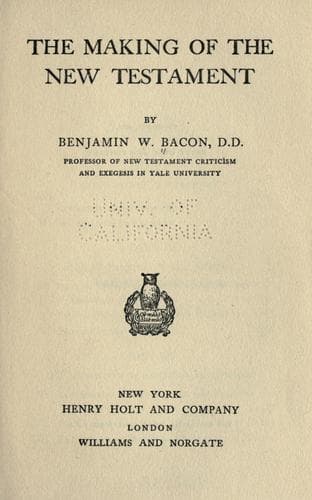
The Making of the New TestamentBacon, Benjamin Wisner
Religion
The Making of the New Testament
Bacon, Benjamin Wisner
Bible. New Testament -- Introductions
Footnote 36: The early death of James the son of Zebedee (Acts xii.
1) excludes him from consideration.
(2) The scene of the prediction of Peter's martyrdom (xxi. 18 f.) is
followed immediately (ver. 20-23) by a reference to traditions which we
know to have been current before the close of the first century
regarding the martyrdom of the two sons of Zebedee, in particular
regarding John. Peter in xxi. 21 raises the question as to the _fate_ of
"the disciple whom Jesus loved" (literally, "and as to this man,
what?"). The pregnant command of Jesus to Peter, "Follow me," is clearly
intended to have reference to martyrdom (_cf._ xiii. 36 f.), and it is
obeyed by "the disciple whom Jesus loved" as well as Peter. Peter's
inquiry and the Lord's reply had given rise "among the brethren" to the
belief that this disciple would "tarry" till the Coming. Now it is of
John, son of Zebedee, and only of him, that we have a curious
vacillation of ancient tradition between belief in his martyrdom in the
same sense as his brother James (Mark x. 39), and a belief (probably
based on Mark ix. 1) that he would tarry as an abiding witness until the
Coming ('white martyrdom'). The writer of the Epilogue has manifestly
these traditions about the fate of John in mind. He would have his
readers understand that the enigmatic prophecy of Jesus neither
promised the permanent survival of John, nor his violent death, but was
at least capable of an interpretation which set John alongside of Peter,
not as a rival of his leadership, or directive control, but simply as a
witness ('martyr') to the truth. Peter is willingly granted the office
of 'ruling elder' in the church, if only "the disciple whom Jesus loved"
may have the function of the prophet and teacher 'in the Spirit,' the
man of faith and insight, whose function it is to interpret 'the mind of
Christ.'
Few things could be more significant of the conditions of Christian life
and thought in the earlier years of the second century than this
Epilogue, appended to the 'spiritual' Gospel to commend it to general
acceptance in the church. It is not vitally important whether the
cautiously suggested identification of the Beloved Disciple with John,
the son of Zebedee, be correct or not. It is important to a historical
appreciation of the great literary contribution of the churches of Paul
to the 'catholic' Christianity of the second century, that we realize
what Petrine catholicity had then come to mean, and how the Pauline
spiritual gospel came half-way to meet it. On this point a study of the
epilogues is rewarding, but especially of the great Epilogue to the
Gospel of John.
Public-domain text, read in full here on John Shaqi.
Reviews
Reviews
No reviews yet
Be the first to share your thoughts on this work.
Elsewhere in the archive
Join the Discussion
Join the discussion
Sign in to leave a comment or review.
Sign InorCreate an account