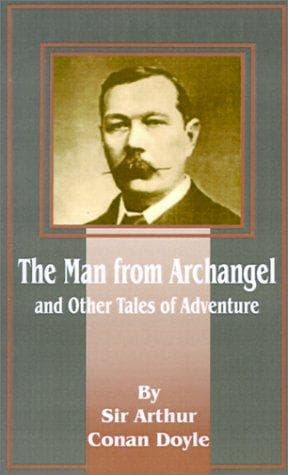
The Man from Archangel, and Other Tales of AdventureDoyle, Arthur Conan
General
The Man from Archangel, and Other Tales of Adventure
Doyle, Arthur Conan
Adventure stories, English; Physicians -- Fiction
As I walked, I entertained myself by recollections of the founders of
Sussex, of Cerdic that mighty sea-rover, and of Ella his son, said by
the bard to be taller by the length of a spear-head than the tallest of
his fellows. I mentioned the matter twice to peasants whom I met upon
the road. One, a tallish man with a freckled face, sidled past me and
ran swiftly towards the station. The other, a smaller and older man,
stood entranced while I recited to him that passage of the Saxon
Chronicle which begins, "Then came Leija with longships forty-four, and
the fyrd went out against him." I was pointing out to him that the
Chronicle had been written partly by the monks of Saint Albans and
afterwards by those of Peterborough, but the fellow sprang suddenly over
a gate and disappeared.
The village of Swinehurst is a straggling line of half-timbered houses
of the early English pattern. One of these houses stood, as I observed,
somewhat taller than the rest, and seeing by its appearance and by the
sign which hung before it that it was the village inn, I approached it,
for indeed I had not broken my fast since I had left London. A stoutish
man, five foot eight perhaps in height, with black coat and trousers of
a greyish shade, stood outside, and to him I talked in the fashion of
the master.
"Why a rose and why a crown?" I asked as I pointed upwards.
He looked at me in a strange manner. The man's whole appearance was
strange. "Why not?" he answered, and shrank a little backwards.
"The sign of a king," said I.
"Surely," said he. "What else should we understand from a crown?"
"And which king?" I asked.
"You will excuse me," said he, and tried to pass.
"Which king?" I repeated.
"How should I know?" he asked.
"You should know by the rose," said I, "which is the symbol of that
Tudor-ap-Tudor, who, coming from the mountains of Wales, yet seated his
posterity upon the English throne. Tudor," I continued, getting between
the stranger and the door of the inn, through which he appeared to be
desirous of passing, "was of the same blood as Owen Glendower, the
famous chieftain, who is by no means to be confused with Owen Gwynedd,
the father of Madoc of the Sea, of whom the bard made the famous cnylyn,
which runs in the Welsh as follows:--"
I was about to repeat the famous stanza of Dafydd-ap-Gwilyn when the
man, who had looked very fixedly and strangely at me as I spoke, pushed
past me and entered the inn. "Truly," said I aloud, "it is surely
Swinehurst to which I have come, since the same means the grove of the
hogs." So saying I followed the fellow into the bar parlour, where I
perceived him seated in a corner with a large chair in front of him.
Four persons of various degrees were drinking beer at a central table,
whilst a small man of active build, in a black, shiny suit, which seemed
to have seen much service, stood before the empty fireplace. Him I took
to be the landlord, and I asked him what I should have for my dinner.
Public-domain text, read in full here on John Shaqi.
Reviews
Reviews
No reviews yet
Be the first to share your thoughts on this work.
Join the Discussion
Join the discussion
Sign in to leave a comment or review.
Sign InorCreate an account