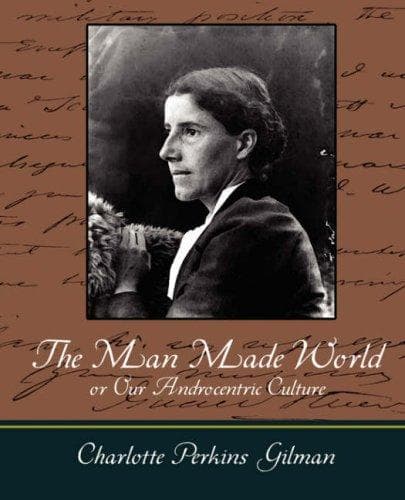
The Man-Made World; Or, Our Androcentric CultureGilman, Charlotte Perkins
General
The Man-Made World; Or, Our Androcentric Culture
Gilman, Charlotte Perkins
Women -- Social and moral questions; Women -- Social conditions
Produced by Christopher Hapka
OUR ANDROCENTRIC CULTURE,
OR THE MAN MADE WORLD
By Charlotte Perkins Gilman
CONTENTS
I. AS TO HUMANNESS.
II. THE MAN-MADE FAMILY.
III. HEALTH AND BEAUTY.
IV. MEN AND ART.
V. MASCULINE LITERATURE.
VI. GAMES AND SPORTS
VII. ETHICS AND RELIGION.
VIII. EDUCATION.
IX. "SOCIETY" AND "FASHION"
X. LAW AND GOVERNMENT.
XI. CRIME AND PUNISHMENT.
XII. POLITICS AND WARFARE. (with WOMAN AND THE STATE.)
XIII. INDUSTRY AND ECONOMICS.
XIV. A HUMAN WORLD.
OUR ANDROCENTRIC CULTURE, or THE MAN-MADE WORLD
I. AS TO HUMANNESS.
Let us begin, inoffensively, with sheep. The sheep is a beast with which
we are all familiar, being much used in religious imagery; the common
stock of painters; a staple article of diet; one of our main sources of
clothing; and an everyday symbol of bashfulness and stupidity.
In some grazing regions the sheep is an object of terror, destroying
grass, bush and forest by omnipresent nibbling; on the great plains,
sheep-keeping frequently results in insanity, owing to the loneliness of
the shepherd, and the monotonous appearance and behavior of the sheep.
By the poet, young sheep are preferred, the lamb gambolling gaily;
unless it be in hymns, where "all we like sheep" are repeatedly
described, and much stress is laid upon the straying propensities of the
animal.
To the scientific mind there is special interest in the sequacity of
sheep, their habit of following one another with automatic imitation.
This instinct, we are told, has been developed by ages of wild crowded
racing on narrow ledges, along precipices, chasms, around sudden spurs
and corners, only the leader seeing when, where and how to jump. If
those behind jumped exactly as he did, they lived. If they stopped to
exercise independent judgment, they were pushed off and perished; they
and their judgment with them.
All these things, and many that are similar, occur to us when we think
of sheep. They are also ewes and rams. Yes, truly; but what of it? All
that has been said was said of sheep, _genus ovis,_ that bland beast,
compound of mutton, wool, and foolishness so widely known. If we think
of the sheep-dog (and dog-ess), the shepherd (and shepherd-ess), of the
ferocious sheep-eating bird of New Zealand, the Kea (and Kea-ess),
all these herd, guard, or kill the sheep, both rams and ewes alike. In
regard to mutton, to wool, to general character, we think only of their
sheepishness, not at all of their ramishness or eweishness. That which
is ovine or bovine, canine, feline or equine, is easily recognized as
distinguishing that particular species of animal, and has no relation
whatever to the sex thereof.
Public-domain text, read in full here on John Shaqi.
Reviews
Reviews
No reviews yet
Be the first to share your thoughts on this work.
Join the Discussion
Join the discussion
Sign in to leave a comment or review.
Sign InorCreate an account