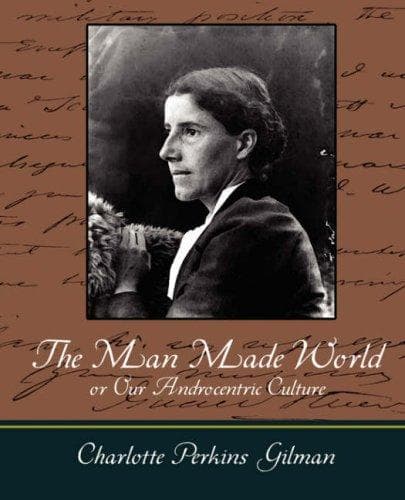
The Man-Made World; Or, Our Androcentric CultureGilman, Charlotte Perkins
General
The Man-Made World; Or, Our Androcentric Culture
Gilman, Charlotte Perkins
Women -- Social and moral questions; Women -- Social conditions
Art as a profession, and the Artist as a professional, came later; and
by that time women had left the freedom and power of the matriarchate
and become slaves in varying degree. The women who were idle pets in
harems, or the women who worked hard as servants, were alike cut off
from the joy of making things. Where constructive work remained to them,
art remained, in its early decorative form. Men, in the proprietary
family, restricting the natural industry of women to personal service,
cut off their art with their industry, and by so much impoverished the
world.
There is no more conspicuously pathetic proof of the aborted development
of women than this commonplace--their lack of a civilized art sense. Not
only in the childish and savage display upon their bodies, but in the
pitiful products they hang upon the walls of the home, is seen the
arrest in normal growth.
After ages of culture, in which men have developed Architecture,
Sculpture, Painting, Music and the Drama, we find women in their
primitive environment making flowers of wax, and hair, and worsted;
doing mottoes of perforated cardboard, making crazy quilts and mats and
"tidies"--as if they lived in a long past age, or belonged to a lower
race.
This, as part of the general injury to women dating from the beginning
of our androcentric culture, reacts heavily upon the world at large.
Men, specializing, giving their lives to the continuous pursuit of one
line of service, have lifted our standard in aesthetic culture, as they
have in other matters; but by refusing the same growth to women, they
have not only weakened and reduced the output, but ruined the market as
it were, hopelessly and permanently kept down the level of taste.
Among the many sides of this great question, some so terrible, some
so pathetic, some so utterly absurd, this particular phase of life is
especially easy to study and understand, and has its own elements of
amusement. Men, holding women at the level of domestic service, going
on themselves to lonely heights of achievement, have found their efforts
hampered and their attainments rendered barren and unsatisfactory by
the amazing indifference of the world at large. As the world at large
consists half of women, and wholly of their children, it would seem
patent to the meanest understanding that the women must be allowed
to rise in order to lift the world. But such has not been the
method--heretofore.
We have spoken so far in this chapter of the effect of men on art
through their interference with the art of women. There are other sides
to the question. Let us consider once more the essential characteristics
of maleness, and see how they have affected art, keeping always in mind
the triune distinction between masculine, feminine and human. Perhaps
we shall best see this difference by considering what the development of
art might have been on purely human terms.
Public-domain text, read in full here on John Shaqi.
Reviews
Reviews
No reviews yet
Be the first to share your thoughts on this work.
Join the Discussion
Join the discussion
Sign in to leave a comment or review.
Sign InorCreate an account