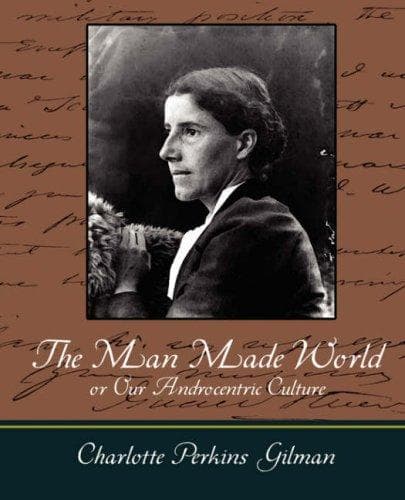
The Man-Made World; Or, Our Androcentric CultureGilman, Charlotte Perkins
General
The Man-Made World; Or, Our Androcentric Culture
Gilman, Charlotte Perkins
Women -- Social and moral questions; Women -- Social conditions
As soon as the male of our species assumed the exclusive right to
perform all social functions, he necessarily brought to that performance
the advantages--and disadvantages--of maleness, of those dominant
characteristics, desire, combat, self-expression.
Desire has overweighted art in many visible forms; it is prominent
in painting and music, almost monopolizes fiction, and has pitifully
degraded dancing.
Combat is not so easily expressed in art, where even competition is on a
high plane; but the last element is the main evil, self-expression. This
impulse is inherently and ineradicably masculine. It rests on that most
basic of distinctions between the sexes, the centripetal and centrifugal
forces of the universe. In the very nature of the sperm-cell and the
germ-cell we find this difference: the one attracts, gathers, draws in;
the other repels, scatters, pushes out. That projective impulse is seen
in the male nature everywhere; the constant urge toward expression, to
all boasting and display. This spirit, like all things masculine, is
perfectly right and admirable in its place.
It is the duty of the male, as a male, to vary; bursting forth in
a thousand changing modifications--the female, selecting, may so
incorporate beneficial changes in the race. It is his duty to thus
express himself--an essentially masculine duty; but masculinity is one
thing, and art is another. Neither the masculine nor the feminine has
any place in art--Art is Human.
It is not in any faintest degree allied to the personal processes
of reproduction; but is a social process, a most distinctive social
process, quite above the plane of sex. The true artist transcends his
sex, or her sex. If this is not the case, the art suffers.
Dancing is an early, and a beautiful art; direct expression of emotion
through the body; beginning in subhuman type, among male birds, as the
bower-bird of New Guinea, and the dancing crane, who swing and caper
before their mates. Among early peoples we find it a common form of
social expression in tribal dances of all sorts, religious, military,
and other. Later it becomes a more explicit form of celebration, as
among the Greeks; in whose exquisite personal culture dancing and music
held high place.
But under the progressive effects of purely masculine dominance we find
the broader human elements of dancing left out, and the sex-element more
and more emphasized. As practiced by men alone dancing has become a mere
display of physical agility, a form of exhibition common to all males.
As practiced by men and women together we have our social dances, so
lacking in all the varied beauty of posture and expression, so steadily
becoming a pleasant form of dalliance.
Public-domain text, read in full here on John Shaqi.
Reviews
Reviews
No reviews yet
Be the first to share your thoughts on this work.
Join the Discussion
Join the discussion
Sign in to leave a comment or review.
Sign InorCreate an account