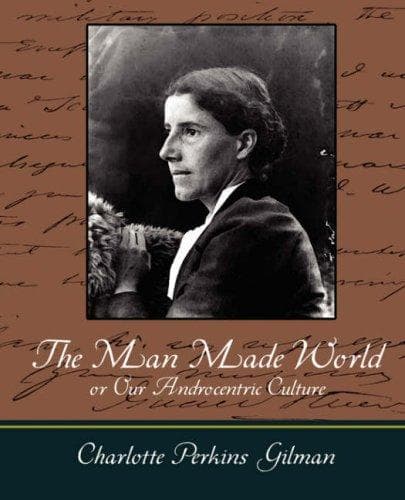
The Man-Made World; Or, Our Androcentric CultureGilman, Charlotte Perkins
General
The Man-Made World; Or, Our Androcentric Culture
Gilman, Charlotte Perkins
Women -- Social and moral questions; Women -- Social conditions
The higher the artist the more human he is, the broader his vision,
the more he sees for humanity, and expresses for humanity, and the less
personal, the less ultra-masculine, is his expression.
V. MASCULINE LITERATURE.
When we are offered a "woman's" paper, page, or column, we find it
filled with matter supposed to appeal to women as a sex or class; the
writer mainly dwelling upon the Kaiser's four K's--Kuchen, Kinder,
Kirche, Kleider. They iterate and reiterate endlessly the discussion
of cookery, old and new; of the care of children; of the overwhelming
subject of clothing; and of moral instruction. All this is recognized as
"feminine" literature, and it must have some appeal else the women would
not read it. What parallel have we in "masculine" literature?
"None!" is the proud reply. "Men are people! Women, being 'the sex,'
have their limited feminine interests, their feminine point of view,
which must be provided for. Men, however, are not restricted--to them
belongs the world's literature!"
Yes, it has belonged to them--ever since there was any. They have
written it and they have read it. It is only lately that women,
generally speaking, have been taught to read; still more lately that
they have been allowed to write. It is but a little while since Harriet
Martineau concealed her writing beneath her sewing when visitors came
in--writing was "masculine"--sewing "feminine."
We have not, it Is true, confined men to a narrowly construed "masculine
sphere," and composed a special literature suited to it. Their effect on
literature has been far wider than that, monopolizing this form of
art with special favor. It was suited above all others to the dominant
impulse of self-expression; and being, as we have seen essentially
and continually "the sex;" they have impressed that sex upon this art
overwhelmingly; they have given the world a masculized literature.
It is hard for us to realize this. We can readily see, that if women had
always written the books, no men either writing or reading them, that
would have surely "feminized" our literature; but we have not in our
minds the concept, much less the word, for an overmasculized influence.
Men having been accepted as humanity, women but a side-issue; (most
literally if we accept the Hebrew legend!), whatever men did or said was
human--and not to be criticized. In no department of life is it easier
to contravert this old belief; to show how the male sex as such
differs from the human type; and how this maleness has monopolized and
disfigured a great social function.
Public-domain text, read in full here on John Shaqi.
Reviews
Reviews
No reviews yet
Be the first to share your thoughts on this work.
Join the Discussion
Join the discussion
Sign in to leave a comment or review.
Sign InorCreate an account