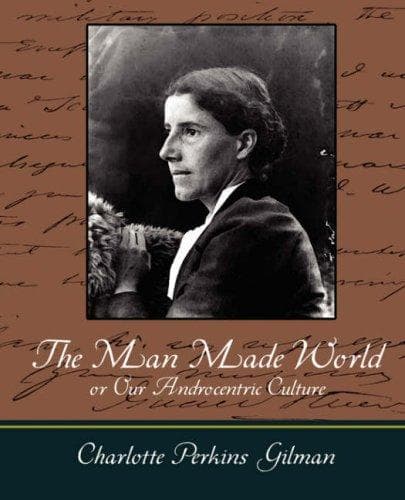
The Man-Made World; Or, Our Androcentric CultureGilman, Charlotte Perkins
General
The Man-Made World; Or, Our Androcentric Culture
Gilman, Charlotte Perkins
Women -- Social and moral questions; Women -- Social conditions
Not only so; but being male, he cares only for male interests. Men,
being the sole arbiters of what should be done and said and written,
have given us not only a social growth scarred and thwarted from the
beginning by continual destruction; but a history which is one unbroken
record of courage and red cruelty, of triumph and black shame.
As to what went on that was of real consequence, the great slow steps of
the working world, the discoveries and inventions, the real progress of
humanity--that was not worth recording, from a masculine point of view.
Within this last century, "the woman's century," the century of the
great awakening, the rising demand for freedom, political, economic, and
domestic, we are beginning to write real history, human history, and not
merely masculine history. But that great branch of literature--Hebrew,
Greek, Roman, and all down later times, shows beyond all question, the
influence of our androcentric culture.
Literature is the most powerful and necessary of the arts, and fiction
is its broadest form. If art "holds the mirror up to nature" this art's
mirror is the largest of all, the most used. Since our very life depends
on some communication; and our progress is in proportion to our fullness
and freedom of communication; since real communication requires mutual
understanding; so in the growth of the social consciousness, we note
from the beginning a passionate interest in other people's lives.
The art which gives humanity consciousness is the most vital art. Our
greatest dramatists are lauded for their breadth of knowledge of "human
nature," their range of emotion and understanding; our greatest poets
are those who most deeply and widely experience and reveal the feelings
of the human heart; and the power of fiction is that it can reach and
express this great field of human life with no limits but those of the
author.
When fiction began it was the legitimate child of oral tradition; a
product of natural brain activity; the legend constructed instead of
remembered. (This stage is with us yet as seen in the constant changes
in repetition of popular jokes and stories.)
Fiction to-day has a much wider range; yet it is still restricted,
heavily and most mischievously restricted.
What is the preferred subject matter of fiction?
There are two main branches found everywhere, from the Romaunt of the
Rose to the Purplish Magazine;--the Story of Adventure, and the Love
Story.
The Story-of-Adventure branch is not so thick as the other by any means,
but it is a sturdy bough for all that. Stevenson and Kipling have proved
its immense popularity, with the whole brood of detective stories and
the tales of successful rascality we call "picaresque" Our most popular
weekly shows the broad appeal of this class of fiction.
Public-domain text, read in full here on John Shaqi.
Reviews
Reviews
No reviews yet
Be the first to share your thoughts on this work.
Join the Discussion
Join the discussion
Sign in to leave a comment or review.
Sign InorCreate an account