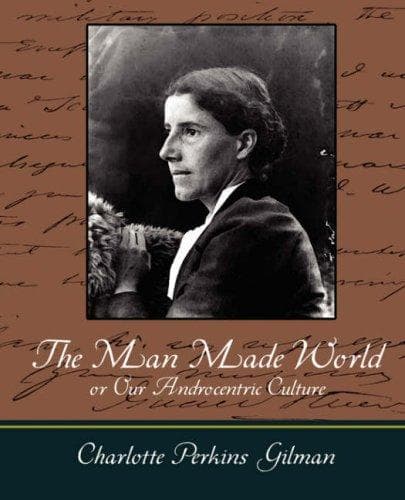
The Man-Made World; Or, Our Androcentric CultureGilman, Charlotte Perkins
General
The Man-Made World; Or, Our Androcentric Culture
Gilman, Charlotte Perkins
Women -- Social and moral questions; Women -- Social conditions
Besides our games and sports we have a large field of "amusements" also
worth examining. We not only enjoy doing things, but we enjoy seeing
them done by others. In these highly specialized days most of our
amusement consists in paying two dollars to sit three hours and see
other people do things.
This in its largest sense is wholly human. We, as social creatures,
can enjoy a thousand forms of expression quite beyond the personal. The
birds must each sing his own song; the crickets chirp in millionfold
performance; but human being feels the deep thrill of joy in their
special singers, actors, dancers, as well as in their own personal
attempts. That we should find pleasure in watching one another is
humanly natural, but what it is we watch, the kind of pleasure and the
kind of performance, opens a wide field of choice.
We know, for instance, something of the crude excesses of aboriginal
Australian dances; we know more of the gross license of old Rome;
we know the breadth of the jokes in medieval times, and the childish
brutality of the bull-ring and the cockpit. We know, in a word, that
amusements vary; that they form a ready gauge of character and culture;
that they have a strong educational influence for good or bad. What we
have not hitherto observed is the predominant masculine influence on
our amusements. If we recall once more the statement with regard to
entertaining anecdotes, "There are thirty good stories in the world, and
twenty-nine of them cannot be told to women," we get a glaring sidelight
on the masculine specialization in jokes.
"Women have no sense of humor" has been frequently said, when "Women
have not a masculine sense of humor" would be truer. If women had thirty
"good stories" twenty-nine of which could not be told to men, it is
possible that men, if they heard some of the twenty-nine, would not
find them funny. The overweight of one sex has told in our amusements as
everywhere else.
Because men are further developed in humanity than women are as yet,
they have built and organized great places of amusement; because they
carried into their humanity their unchecked masculinity, they have made
these amusements to correspond. Dramatic expression, is in its true
sense, not only a human distinction, but one of our noblest arts. It is
allied with the highest emotions; is religious, educational, patriotic,
covering the whole range of human feeling. Through it we should be able
continually to express, in audible, visible forms, alive and moving,
whatever phase of life we most enjoyed or wished to see. There was a
time when the drama led life; lifted, taught, inspired, enlightened. Now
its main function is to amuse. Under the demand for amusement, it has
cheapened and coarsened, and now the thousand vaudevilles and picture
shows give us the broken fragments of a degraded art of which our one
main demand is that it shall make us laugh.
Public-domain text, read in full here on John Shaqi.
Reviews
Reviews
No reviews yet
Be the first to share your thoughts on this work.
Join the Discussion
Join the discussion
Sign in to leave a comment or review.
Sign InorCreate an account