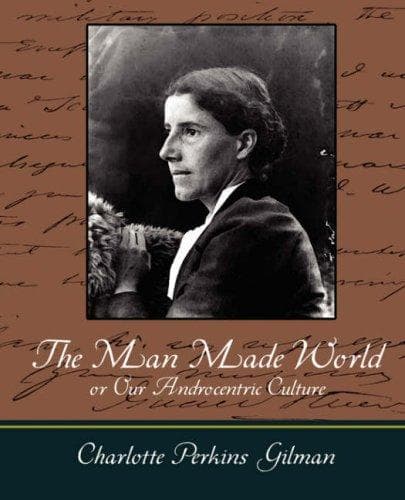
The Man-Made World; Or, Our Androcentric CultureGilman, Charlotte Perkins
General
The Man-Made World; Or, Our Androcentric Culture
Gilman, Charlotte Perkins
Women -- Social and moral questions; Women -- Social conditions
Let us note first that while the underlying laws of ethics remain steady
and reliable, human notions of them have varied widely and still do
so. In different races, ages, classes, sexes, different views of ethics
obtain; the conduct of the people is modified by their views, and their
prosperity is modified by their conduct.
Primitive man became very soon aware that conduct was of importance. As
consciousness increased, with the power to modify action from within,
instead of helplessly reacting to stimuli from without, there arose the
crude first codes of ethics, the "Thou shalt" and "Thou shalt not" of
the blundering savage. It was mostly "Thou shalt not." Inhibition, the
checking of an impulse proven disadvantageous, was an earlier and easier
form of action than the later human power to consciously decide on and
follow a course of action with no stimulus but one's own will.
Primitive ethics consists mostly of Tabus--the things that are
forbidden; and all our dim notions of ethics to this day, as well as
most of our religions, deal mainly with forbidding.
This is almost the whole of our nursery government, to an extent shown
by the well-worn tale of the child who said her name was "Mary." "Mary
what?" they asked her. And she answered, "Mary Don't." It is also the
main body of our legal systems--a complex mass of prohibitions and
preventions. And even in manners and conventions, the things one should
not do far outnumber the things one should. A general policy of negation
colors our conceptions of ethics and religion.
When the positive side began to be developed, it was at first in purely
arbitrary and artificial form. The followers of a given religion were
required to go through certain motions, as prostrating themselves,
kneeling, and the like; they were required to bring tribute to the gods
and their priests, sacrifices, tithes, oblations; they were set little
special performances to go through at given times; the range of things
forbidden was broad; the range of things commanded was narrow. The
Christian religion, practically interpreted, requires a fuller "change
of heart" and change of life than any preceding it; which may account at
once for its wide appeal to enlightened peoples, and to its scarcity of
application.
Again, in surveying the field, it is seen that as our grasp of ethical
values widened, as we called more and more acts and tendencies "right"
and "wrong," we have shown astonishing fluctuations and vagaries in our
judgment. Not only in our religions, which have necessarily upheld each
its own set of prescribed actions as most "right," and its own special
prohibitions as most "wrong"; but in our beliefs about ethics and our
real conduct, we have varied absurdly.
Public-domain text, read in full here on John Shaqi.
Reviews
Reviews
No reviews yet
Be the first to share your thoughts on this work.
Join the Discussion
Join the discussion
Sign in to leave a comment or review.
Sign InorCreate an account