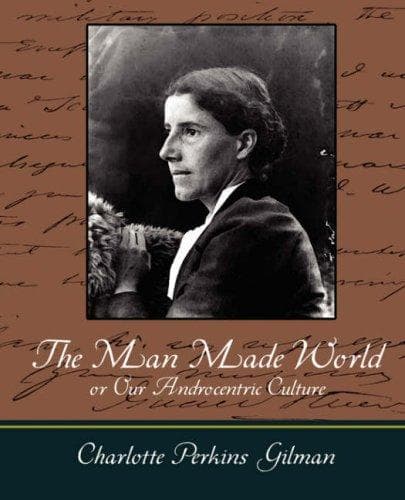
The Man-Made World; Or, Our Androcentric CultureGilman, Charlotte Perkins
General
The Man-Made World; Or, Our Androcentric Culture
Gilman, Charlotte Perkins
Women -- Social and moral questions; Women -- Social conditions
If we saw women in absolute freedom, with a separate religion devised
by women, practiced by women, and remaining unchanged through the
centuries; while men, on the other hand, bounded bravely forward, making
new ones as fast as they were needed, this belief might be maintained.
But what do we see? All the old religions made by men, and forced on the
women whether they liked it or not. Often women not even considered
as part of the scheme--denied souls--given a much lower place in the
system--going from the service of their father's gods to the service of
their husbands--having none of their own. We see religions which make
practically no place for women, as with the Moslem, as rigidly bigoted
and unchanging as any other.
We see also this: that the wider and deeper the religion, the more
human, the more it calls for practical applications in Christianity--the
more it appeals to women. Further, in the diverging sects of the
Christian religion, we find that its progressiveness is to be measured,
not by the numbers of its women adherents, but by their relative
freedom. The women of America, who belong to a thousand sects, who
follow new ones with avidity, who even make them, and who also leave
them all as men do, are women, as well as those of Spain, who remain
contented Romanists, but in America the status of women is higher.
The fact is this: a servile womanhood is in a state of arrested
development, and as such does form a ground for the retention of ancient
ideas. But this is due to the condition of servility, not to womanhood.
That women at present are the bulwark of the older forms of our
religions is due to the action of two classes of men: the men of the
world, who keep women in their restricted position, and the men of the
church, who take every advantage of the limitations of women. When we
have for the first time in history a really civilized womanhood, we can
then judge better of its effect on religion.
Meanwhile, we can see quite clearly the effect of manhood. Keeping in
mind those basic masculine impulses--desire and combat--we see them
reflected from high heaven in their religious concepts. Reward!
Something to want tremendously and struggle to achieve! This is a
concept perfectly masculine and most imperfectly religious. A religion
is partly explanation--a theory of life; it is partly emotion--an
attitude of mind, it is partly action--a system of morals. Man's special
effect on this large field of human development is clear. He pictured
his early gods as like to himself, and they behaved in accordance with
his ideals. In the dimmest, oldest religions, nearest the matriarchate,
we find great goddesses--types of Motherhood, Mother-love, Mother-care
and Service. But under masculine dominance, Isis and Ashteroth dwindle
away to an alluring Aphrodite--not Womanhood for the child and the
World--but the incarnation of female attractiveness for man.
Public-domain text, read in full here on John Shaqi.
Reviews
Reviews
No reviews yet
Be the first to share your thoughts on this work.
Join the Discussion
Join the discussion
Sign in to leave a comment or review.
Sign InorCreate an account