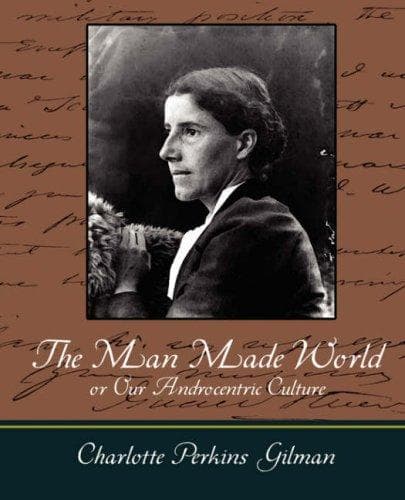
The Man-Made World; Or, Our Androcentric CultureGilman, Charlotte Perkins
General
The Man-Made World; Or, Our Androcentric Culture
Gilman, Charlotte Perkins
Women -- Social and moral questions; Women -- Social conditions
Both of them we idealize in certain lines, and exploit in others.
Both of them are misinterpreted, balked of their full usefulness, and
humanity thus injured.
The human race does not get the benefit of the full powers of women, nor
of the full powers of the state.
In all civilized races to-day there is a wide and growing sense of
discontent among women; a criticism of their assigned limitations, and
a demand for larger freedom and opportunity. Under different conditions
the demand varies; it is here for higher education, there for justice
before the law; here for economic independence, and there for political
equality.
This last is at present the most prominent Issue of "the woman question"
in England and America, as the activity of the "militant suffragists"
has forced it upon the attention of the world.
Thoughtful people in general are now studying this point more seriously
than ever before, genuinely anxious to adopt the right side, and there
is an alarmed uprising of sincere objection to the political equality of
women.
Wasting no time on ignorance, prejudice, or the resistance of special
interests, let us fairly face the honest opposition, and do it justice.
The conservative position is this:
"Men and women have different spheres in life. To men belong the creation
and management of the state, and the financial maintenance of the home
and family:
"To women belong the physical burden of maternity, and the industrial
management of the home and family; these duties require all their time
and strength:
"The prosperity of the state may be sufficiently conserved by men alone;
the prosperity of the family requires the personal presence and services
of the mother in the home: if women assume the cares of the state, the
home and family will suffer:"
Some go even farther than this, and claim an essential limitation
in "the female mind" which prevents it from grasping large political
interests; holding, therefore, that if women took part in state affairs
it would be to the detriment of the community:
Others advance a theory that "society," in the special sense, is the
true sphere of larger service for women, and that those of them not
exclusively confined to "home duties" may find full occupation in
"social duties," including the time honored fields of "religion" and
"charity":
Others again place their main reliance on the statement that, as to the
suffrage, "women do not want it."
Let us consider these points in inverse order, beginning with the last
one.
We will admit that at present the majority of women are not consciously
desirous of any extension of their political rights and privileges, but
deny that this indifference is any evidence against the desirability of
such extension.
Public-domain text, read in full here on John Shaqi.
Reviews
Reviews
No reviews yet
Be the first to share your thoughts on this work.
Elsewhere in the archive
Join the Discussion
Join the discussion
Sign in to leave a comment or review.
Sign InorCreate an account