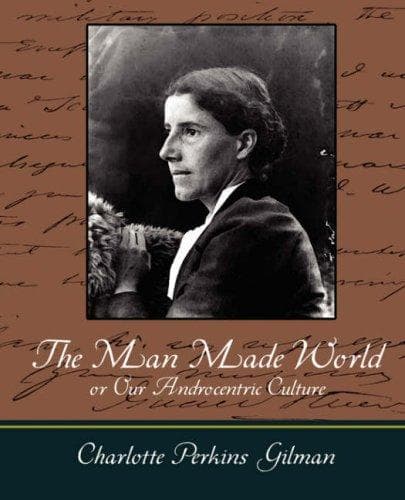
The Man-Made World; Or, Our Androcentric CultureGilman, Charlotte Perkins
General
The Man-Made World; Or, Our Androcentric Culture
Gilman, Charlotte Perkins
Women -- Social and moral questions; Women -- Social conditions
It has long been accepted that the position of women is an index of
civilization. Progressive people are proud of the freedom and honor
given their women, and our nation honestly believes itself the leader
in this line. "American women are the freest in the world!" we say; and
boast of it.
Since the agitation for women's rights began, many concessions have
been made to further improve their condition. Men, seeing the justice
of certain demands, have granted in many states such privileges as
admission to schools, colleges, universities, and special instruction
for professions; followed by admission to the bar, the pulpit, and the
practice of medicine. Married women, in many states, have now a right
to their own earnings; and in a few, mothers have an equal right in the
guardianship of their children.
We are proud and glad that our women are free to go unveiled, to travel
alone, to choose their own husbands; we are proud and glad of every
extension of justice already granted by men to women.
Now:--Have any of these concessions been granted because a majority of
women asked for them? Was it advanced in opposition to any of them that
"women did not want it?" Have as many women ever asked for these things
as are now asking for the ballot? If it was desirable to grant these
other rights and privileges without the demand of a majority, why is the
demand of a majority required before this one is granted?
The child widows of India did not unitedly demand the abolition of the
"suttee."
The tortured girl children of China did not rise in overwhelming
majority to demand free feet; yet surely no one would refuse to lift
these burdens because only a minority of progressive women insisted on
justice.
It is a sociological impossibility that a majority of an unorganized
class should unite in concerted demand for a right, a duty, which they
have never known.
The point to be decided is whether political equality is to the
advantage of women and of the state--not whether either, as a body, is
asking for it.
Now for the "society" theory. There is a venerable fiction to the
effect that women make--and manage, "society." No careful student of
comparative history can hold this belief for a moment. Whatever the
conditions of the age or place; industrial, financial, religious,
political, educational; these conditions are in the hands of men; and
these conditions dictate the "society" of that age or place.
Public-domain text, read in full here on John Shaqi.
Reviews
Reviews
No reviews yet
Be the first to share your thoughts on this work.
Elsewhere in the archive
Join the Discussion
Join the discussion
Sign in to leave a comment or review.
Sign InorCreate an account