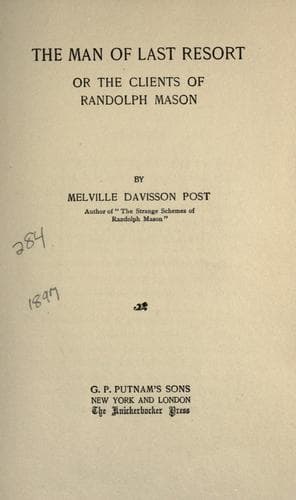
The Man of Last Resort; Or, The Clients of Randolph MasonPost, Melville Davisson
General
The Man of Last Resort; Or, The Clients of Randolph Mason
Post, Melville Davisson
American fiction -- 19th century; Detective and mystery stories, American; Legal stories, American
He had made his argument then, and it was good. The venture was
perfectly legitimate, so recognized and treated by the business men
of the land,--nay, more, it was so regarded by the law. These were the
standards; there was no other. The customs of business and the law were
the rules of right in the marketplaces. Their wisdom was unquestioned.
It was the result of all the experience of the race, the conclusion of
wise men, laboring with conditions as they were. Had she a right to say
that these standards were wrong? He appealed to her sense of fairness.
Was she better able to pass upon the right of this transaction than all
the merchants learned in the customs of trade,--than all the jurists
learned in the wisdom of the law? Was she better able?
Carper pointed out that she lived in an atmosphere of purity high above
the din of the fight for life; a land of refined right, refined justice,
refined honor, magnificent, but not the world. The world had no perfect
code; it was no perfect place; it was not intended to be so, else it
would have been so made. It was an indifferent place, governed by the
inexorable law of the survival of the fittest, wherein men struggled for
footing and the comforts of life. One must conform to conditions as they
were, or go to the wall. It was folly, it was idiocy, it was madness to
do otherwise.
Trade was like nature--pitiless. There was no measure of consideration
for the weakling or the fool. The fight was bitter, remorseless, subject
to dangerous shifts. If one was caught and broken, the blame was with
the sorry scheme of things, and this a Divine Intelligence maintained,
and men could not question that Divine Intelligence. This condition of
the world might not be purest or happiest, but it was the condition of
the world. It was God's way. Was it wise to call it evil?
Then he shifted. He bade her remember that she had promised to go
through life with him. It was a contract she had no right to break.
The position she was taking was a frightful contradiction. She was
reprehending the customs of trade, and yet there was not a merchant in
the market-place who would repudiate his contract. She was charging the
law with failure to appreciate the highest shades of right, and yet
she was about to do what the law, even in its grossness, recognized and
punished as a wrong. She could not stand upon this ground, and do as
she was doing. Even if he had done wrong, was she to punish him by doing
wrong also? The vice of her position cried out. Her promise had
been given. It was immutable. It was her affair to know her mind, to
determine what she wanted to do. She had known him for years. In those
years there had been ample time to investigate, to conclude, to decide.
No one had abridged the freedom of her agency. She had finally become
a party to this contract. Could she repudiate it now, like the common
rogue in whom principle was wanting?
Public-domain text, read in full here on John Shaqi.
Reviews
Reviews
No reviews yet
Be the first to share your thoughts on this work.
Elsewhere in the archive
Join the Discussion
Join the discussion
Sign in to leave a comment or review.
Sign InorCreate an account