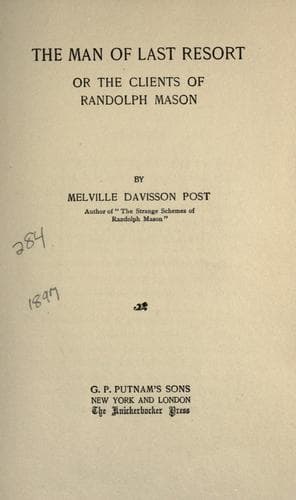
The Man of Last Resort; Or, The Clients of Randolph MasonPost, Melville Davisson
General
The Man of Last Resort; Or, The Clients of Randolph Mason
Post, Melville Davisson
American fiction -- 19th century; Detective and mystery stories, American; Legal stories, American
The man placed the picture on the mantelshelf, and sat down by the
fire. That day was now seven years gone,--seven years! Yesterday was no
farther back. Every detail was clear. The shock had stamped them on the
lining of his heart. He had loved this woman as a man loves just one
time. He was trusting his very life to her keeping; he was going to her
for everything that woman could give; all of sweet fellowship, all of
tender sympathy, all of love. She was the only woman in the world. The
expression is a platitude, but the fact was as real to Carper as the
green trees and the sunlight. One could no more have convinced this man
that other women held some of the charms of life, than one could have
convinced him that light was a liquid. His love had gained the power of
a religion; it had gone, farther---it had gained the majesty of a law.
Then the blow came. Carper had gone to this woman with a case of jewels,
the profit of a venture. He remembered how happy she had been: how the
light of trustfulness danced in her eyes; how she had carried the jewels
to the window in order to see the great rubies change to blood-drops,
then she had turned with a playful smile and asked him how he had made
so great a sum, and he, like a miserable fool, had blurted out that it
was a part of his gains in a deal on the street,--a deal in which he
had ruined a little banking house by seizing the vantage of its ignorant
mistake. It was the master blunder.
Carper remembered how the blood faded from this woman's face, leaving it
ashen gray; how the dull ache of pain gathered in her eyes; how she had
come over to him and dropped the jewels slowly into their case, and,
without a word, had gone back and sat down by the window. And he knew
that the woman of his love was gone out beyond the reach of his fingers.
The leash of his love had slipped off and snapped back in his hands.
He remembered the effect upon himself as something entirely foreign to
that which writers attribute to men under similar conditions. There
was no benumbing horror; no desire to make any violent demonstration of
feeling. There was merely a vague loss of strength, as though the
bottom of the fountain of vital force had dropped out, and then he grew
sick--physically sick. The material man was hurt first, and collapsed,
much as it would have done if shot through the stomach with a shell. He
felt none of that exaggerated emotion affected by the play-actor.
It was the commonplace sickness of a frightful physical blow.
When the nausea had passed, he had gone over to her and begged to know
what it all meant, although he knew quite as well as she. The woman had
looked at him with her wide eyes deadened with pain, and said that she
had believed him ah honorable man, and had loved him for it, but that
now she knew the truth, and she would never be wife to a dishonest man.
Public-domain text, read in full here on John Shaqi.
Reviews
Reviews
No reviews yet
Be the first to share your thoughts on this work.
Elsewhere in the archive
Join the Discussion
Join the discussion
Sign in to leave a comment or review.
Sign InorCreate an account