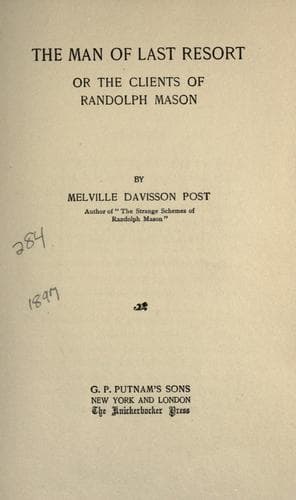
The Man of Last Resort; Or, The Clients of Randolph MasonPost, Melville Davisson
General
The Man of Last Resort; Or, The Clients of Randolph Mason
Post, Melville Davisson
American fiction -- 19th century; Detective and mystery stories, American; Legal stories, American
When the population gathered night after night under the roof of his
Emporium, their troubles came also; and when the smoke grew thick and
the tanglefoot whiskey began to assert itself, there were other things
to clear up beside matters of currency. Matters of consequence and
matters of no consequence were cleared by the same rapid, drastic
measures. Bad men here decided who was the worst or the best, as they
were pleased with the term. The henchmen of rival cattle kings submitted
the vexatious question of a brand on a stray heifer to this court of
instant resort and quick decision, and other concerns of the citizen,
affecting perhaps his truth, or honor, or ability for a vice, were
determined suddenly and for all time without the wrangling of counsel or
the tedium of courts.
If a Mexican was so short sighted as to slip his knife into a
tenderfoot, some one shot the Mexican, and the crowd “lickered up.” If
the faro dealer killed his man, it was usually because the man needed
killing, and certainly the faro dealer was the best judge of this.
On the contrary, if one shot the dealer, this was considered a public
calamity, demanding an explanation, since the dealer was a _quasi_
public functionary, and the convenience of the citizen required that the
game should continue. One's life was perhaps the cheapest thing below
the Central Pacific Railroad, and it was entirely the duty of the
individual to see that it was maintained. If one was unsteady on the
trigger, or caught napping on the draw, one was held to have died by
virtue of contributory negligence.
To be sure there was law, and machinery for its execution; but the
machinery was liberal, and had ideas of its own, and the law adhered
with supreme unconcern to its maxim--_De minimis non curat lex_.
First Class Crawley had been splendidly trained for the duties of his
position. If Fortune had been moving of design, she could not have
schooled him better for such a life. Some thirty years before, he had
been a sutler with the Army of the Potomac--not the sutler of romance,
but the sutler of reality; following the army bravely, but at such a
distance to the rear as to be at all times extremely safe, and exacting
for his valuable public service every gain that human ingenuity could
discover. It was no wrong in the mind of Crawley to cheat the common
soldier out of his eyes; belike the soldier would be shot on the
morrow, and then all opportunity to cheat him would cease, and if prior
opportunity had not been seized and enjoyed, Crawley would regret.
Public-domain text, read in full here on John Shaqi.
Reviews
Reviews
No reviews yet
Be the first to share your thoughts on this work.
Join the Discussion
Join the discussion
Sign in to leave a comment or review.
Sign InorCreate an account