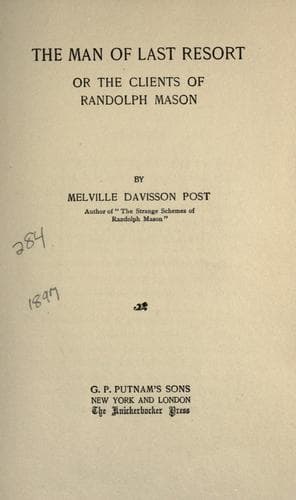
The Man of Last Resort; Or, The Clients of Randolph Mason — John Shaqi
The Man of Last Resort; Or, The Clients of Randolph MasonPost, Melville Davisson
General
The Man of Last Resort; Or, The Clients of Randolph Mason
Post, Melville Davisson
American fiction -- 19th century; Detective and mystery stories, American; Legal stories, American
The father of young Dalton had been a man of improvident habits, and,
immediately upon the death of his wife, squandered his large estate
in the riot of dissipation, so that his son inherited nothing but a
dilapidated manor-house and a single slave. This servant, a pure negro,
was deeply attached to young Dalton, and the two continued to reside in
the manor-house near the city suburbs, the negro acting as cook, valet,
and man-of-all-work. This manor house was one of the first built in
the Virginias. It was surrounded by a long, ill-kept lawn, in which
the ancient knotted oaks seemed to stand guard over the memory of some
departed greatness. The house itself, covered with the green Virginia
creeper, was little better than a ruin. The plaster had fallen away from
the great pillars, and the walls were cracked, in places, almost to the
roof.
Strangely enough, Robert Dalton never attempted to repair the estate,
taking pride rather in its air of decay. This statement is not entirely
accurate. He did, indeed, fit up the ancient drawing-room for the
purposes of a library, thrusting in rows of bookcases beside long
antique mirrors and mahogany window seats. These bookcases were
filled entirely with reports of courts, late digests, the decisions of
tribunals of last resort, and volume after volume on wills, contracts,
and corporations, but scarcely a volume on standard or current
literature. For these latter he had no inclination, and, as he
apologetically explained, no time.
In this library, Dalton did most of his legal work, obtaining here
freedom from interruption and the quiet which he required.
As the city developed, this neglected suburban street was seized upon
and assumed as the fashionable quarter by the wealthy Eastern families.
They paved it far into the country, and ruthlessly wiped out the
splendid old homesteads, erecting on their ruins ostentatious palaces
with prim lawns, reminding one not a little of that civilized vandalism
which would cut out from its frame the superb painting of a landscape
and replace therein a practical and entirely accurate map of the same
landscape.
These wealthy families swept out, too, the old social customs of this
city, setting up elaborate formalities and impoverishing standards of
dress and entertainment.
The recognized leader was Mrs. LeConte Dean, the wife of a nail
manufacturer of vast wealth. Her receptions were the society events.
Indeed, it has been said that recognition by this newly rich importation
determined one's social status.
Public-domain text, read in full here on John Shaqi.
Reviews
Reviews
No reviews yet
Be the first to share your thoughts on this work.
Join the Discussion
Join the discussion
Sign in to leave a comment or review.
Sign InorCreate an account