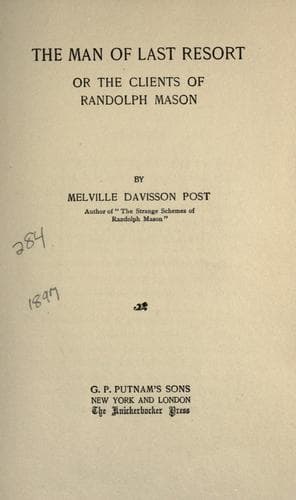
The Man of Last Resort; Or, The Clients of Randolph MasonPost, Melville Davisson
General
The Man of Last Resort; Or, The Clients of Randolph Mason
Post, Melville Davisson
American fiction -- 19th century; Detective and mystery stories, American; Legal stories, American
To the negro miner, seven miles up at the town of Welch, this rugged
crossing, studded with great bowlders, was respectfully referred to as
“Hell's Gap,”--respectfully, for no other reason than that the negroes
were superstitious, and the mammoth gorge, silent as the grave floor,
and deep and foggy except in the long summer afternoons, was calculated
to conjure every grim phantom set down in the African catalogue.
The sheriff pulled up his “dun” horse suddenly, and threw his leg over
the pommel of his saddle. Just below him in the ford of the river was
a man wading out into the water,--a tall mountaineer, bare-headed, his
dress indicating a rather equal compromise between the barbarity of the
village and the barbarity of the mountain. For upper garment he wore the
red-fringed hunting shirt of his fathers and his grandfathers and on;
and for nether garment, the blue overalls purchased at the country store
for a haunch of venison or a bundle of hides. The mountaineer was tall,
rugged, and powerful,--a proper inhabitant for such a place.
“Spitler Hamrick,” murmured the sheriff.
“By every limping god! The toughest pine knot in the mountains of
McDowell. I wonder what the old wolf is looking for.”
Then he tightened his knee on the pommel of the saddle and a slow smile
crept over the features of the sheriff. “By my troth'” he drawled, “it
is certain that Spitler is no Vere de Vere. Still, if blue blood ran
to back, and bunches of muscles on the shoulders, Spitler's claim to
princely lineage would be unquestioned.”
White Carter stopped short, and adjusted his eye-glasses. The
mountaineer had gathered up a bundle from the river and was turning to
wade ashore. The man did not at once see the sheriff; he was looking
down into the water in order to avoid slipping on the smooth stones.
When he stepped on to the rocky bank of the river, the sheriff called.
At the sound, the mountaineer dropped the bundle and jerked up a
Winchester that lay nearby against a bowlder. It was an act after the
custom of the mountains. One armed himself first, and observed the “lay
of the land” afterwards.
White Carter remained perfectly motionless. “I would n't shoot,
Spitler,” he drawled, “it's vulgar.”
The mountaineer dropped the butt of his rifle on the stones, and looked
up in astonishment. “Smoky hell!” ejaculated the mountaineer, “it air
the sheriff. Smoky hell!” The refrain was a nervous idiom with Spitler
Hamrick.
White Carter put his hand into the pocket of his coat, took out a
pipe, knocked the ashes from the bowl and began to fill it with
great deliberation. This act, remaining after the red man had passed,
proclaimed a status of dignified truce.
The play of action faded from Hamrick's face, leaving it stolid, heavy,
prodigiously indifferent. It was the mountain's stamp on its minion, the
silence, and the abominable indifference of the rugged earth ground into
the faces of the men who struggle for life on her stony breast.
Public-domain text, read in full here on John Shaqi.
Reviews
Reviews
No reviews yet
Be the first to share your thoughts on this work.
Elsewhere in the archive
Join the Discussion
Join the discussion
Sign in to leave a comment or review.
Sign InorCreate an account