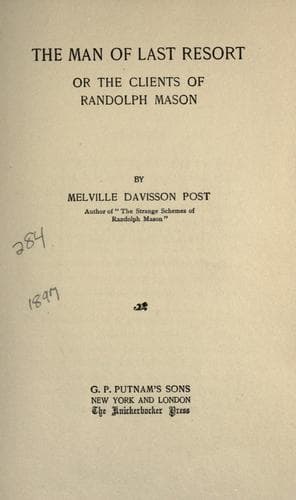
The Man of Last Resort; Or, The Clients of Randolph MasonPost, Melville Davisson
General
The Man of Last Resort; Or, The Clients of Randolph Mason
Post, Melville Davisson
American fiction -- 19th century; Detective and mystery stories, American; Legal stories, American
“Hot,” observed the sheriff, crowding the bowl of his pipe and thrusting
the tobacco down with his broad thumb.
The mountaineer folded his arms over the muzzle of his rifle and leaned
upon it heavily.
“Yas,” he responded, “warmish,”
It was the full measure of salutation, and the full measure of
introduction to all matters, important or unimportant, on the watershed
of the Alleghanies. In the mountains no man hurried with his speech.
There was time to be fully understood, and time to answer fully; then
what one did afterwards, one was not so likely to regret. In the flat
lands men are not so wise, perhaps.
The sheriff struck a match on his saddle skirt, lighted his pipe, and
puffed a cloud of blue smoke rings out over the placid ears of the
“murky dun.” Presently he took the pipe stem from between his teeth and
looked down at the solitary proprietor of Jim's Ford.
“Spitler,” he drawled, “what 's in the bundle?”
“Ye kin look,” responded the mountaineer with prodigious unconcern.
The sheriff replaced his pipe and lapsed into silence for a moment. Then
he said:
“Where did you find it, Spitler?”
“I reckin ye saw,” replied the scion of the house of Hamrick.
The guardian of order looked up at the blue sky over the top of his nose
glasses. Then he looked down. “Spitler,”--he said softly.
The mountaineer interrupted. “Sheriff,” he growled, “old Spitler Hamrick
don't stand no shammackin' round the bush. Smoky hell! He aint never
stood it. Things air goin' to be like this: ye kin mosey' down here and
git this bundle, air ye kin ride on. But ye can't set on you hoss and
jaw. Smoky hell! Ye can't set on you hoss and jaw.”
There was no circumlocution, no trick of equivocation, no shadow of
obscurity in the speech of the denizen of Hell's Gap He used words for
the purpose of expressing exactly what he believed to be true, and for
no other purpose. This the sheriff knew, and others had learned and
remembered by certain long glistening scars, covered afterward with the
red flannel of their hunting shirts.
White Carter removed his knee from the pommel of his saddle and slipped
down to the ground. Here he paused for a moment, knocked the ashes from
his pipe and replaced it in his pocket. Then he clambered down the steep
bank to the river. The proprietor of Jim's Ford looked on with mighty
indifference. The sheriff took up the bundle without a word, returned to
his horse, and unbuckling the “throat latch” of his bridle, strapped the
bundle to the horn of his saddle. Then he placed his right foot in the
stirrup and turned to the mountaineer.
“Spitler,” he drawled, “we found a dead man in Tug the other day. I
think this is his coat.”
The mountaineer looked up from the muzzle of his Winchester. “Were there
lead in him?” he asked.
The sheriff flung his leg over the saddle and gathered up his bridle
from the horse's neck.
“No bullet holes,” he answered.
“Then,” said the giant Hamrick, “he were not killed in the hills.”
IV
Public-domain text, read in full here on John Shaqi.
Reviews
Reviews
No reviews yet
Be the first to share your thoughts on this work.
Elsewhere in the archive
Join the Discussion
Join the discussion
Sign in to leave a comment or review.
Sign InorCreate an account