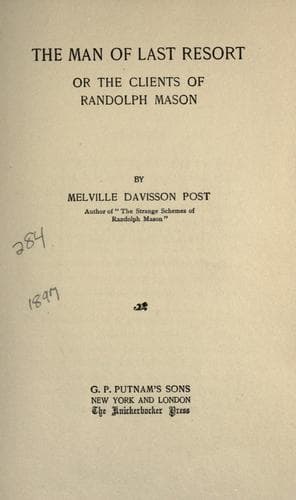
The Man of Last Resort; Or, The Clients of Randolph MasonPost, Melville Davisson
General
The Man of Last Resort; Or, The Clients of Randolph Mason
Post, Melville Davisson
American fiction -- 19th century; Detective and mystery stories, American; Legal stories, American
He told how he had trailed this matter down; how the Octagon Coal
Company was financially on the verge of ruin, and it was his theory that
Gilmore, as president, had been stealing largely from the company;
that Hirst had finally suspected this theft and had summoned Gilmore to
McDowell; how the dangerous man had obeyed the summons, had quarrelled
with Hirst in the office, finally killed him, and in order to cover the
crime had carried the body to the bridge and thrown it over, arranging
the evidence to appear like a suicide. He painted in lurid colors the
desperate character of this man Gilmore; he pointed out how fearful of
arrest the murderer of Hirst was, at that very hour hurrying westward in
order, as he believed, to put himself beyond the reach of the law.
The witness talked on glib and shrewdly, and while he talked, the jury,
unfamiliar with the rules of evidence, grew indignant and bitter, and
fired with a sense of the gigantic outrage.
Presently the door opened and the prosecuting attorney entered with the
indictment.
“Are you ready to vote on the matter, gentlemen?” he asked.
The foreman nodded slowly. “I guess we are, Jeb,” he answered.
“Then,” responded the prosecuting attorney, “Mr. Bartlett and myself
will withdraw.”
The witness arose and followed Mr Huron out of the jury room.
When the door had closed, the chief inquisitor from Charity Fork picked
up the indictment., turned it over curiously in his ponderous hand, and
then laid it down on the table with the back up. Then he took up his
pen and jabbed it down into the ink pot.
“Boys,” he observed, cheerily, “the Good Book says, 'None shall escape,
no not one.' What about this here one?”
“I reckon,” drawled Uriah Coburn, sage and philosopher, and most
venerable member from Injun Run, “I reckon the Good Book air right, I
reckon we better flop him.”
“Flop” was an accurate idiom in McDowell, and, being translated, meant,
“to throw heavily.”
To this the grand jury agreed with many and various methods of assent.
So the member from Charity Fork took a new grip on his pen, thrust his
tongue out of the corner of his mouth, and slowly and with great labor
inscribed on the back of the indictment this legend, big with the
injured dignity of the Commonwealth: “A True Bill. Abraham Collister,
Foreman.”
V
Public-domain text, read in full here on John Shaqi.
Reviews
Reviews
No reviews yet
Be the first to share your thoughts on this work.
Elsewhere in the archive
Join the Discussion
Join the discussion
Sign in to leave a comment or review.
Sign InorCreate an account