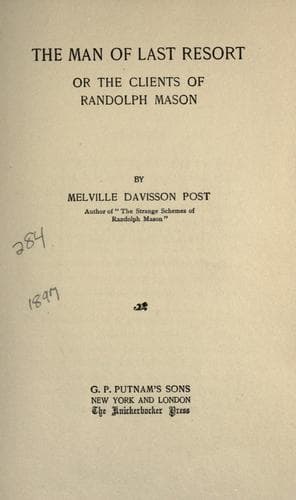
The Man of Last Resort; Or, The Clients of Randolph MasonPost, Melville Davisson
General
The Man of Last Resort; Or, The Clients of Randolph Mason
Post, Melville Davisson
American fiction -- 19th century; Detective and mystery stories, American; Legal stories, American
AT high noon on the following day Salathiel Jenkins, chief deputy of
the absent Carter, was a voluble factor in McDowell. He explained with
many a dash of color just how “me and Bartlett” had taken the fleeing
Gilmore from a midnight train and transported him to the jail at Welch,
where he now languished. How brave they had been, how expeditious, and
how marvellously successful in each of their desperate moves. Salathiel
Jenkins was a young person who considered himself of huge importance to
the economy of nature,--an opinion with which the world at large failed
to concur. The conservative Carter had expressed it all long ago when he
remarked with immense gravity that Salathiel Jenkins was not wise. But
the deputy's potential was high, and he talked. He explained that
the prisoner had employed legal counsel, with whom he had been in
consultation since his arrival in the town. He explained that Mr.
Bartlett had advised the prosecuting attorney to force the case to a
trial at once in order to avoid an application for bail, and in order
to prevent the prisoner from being unduly assisted by any accomplice he
might have in the East.
He explained that the evidence against Gilmore was overpowering, that
there were witnesses who knew something of the matter, and he had the
subpoenas in his pocket.
He explained that John Bartlett was the greatest detective in the
Republic, and that the days on earth of Robert Gilmore were growing
lamentably short. The self-importance of young Mr. Jenkins gushed
and bubbled and expanded until it threatened to bulge his anatomical
proportions, and he talked and he talked. He descanted with acrimonious
criticism upon the fact that Mr. Huron had asked for time in which to
examine the evidence, and that he and the great Bartlett had labored to
convince him that the case should be put to trial at once, and that they
had had a lot of trouble, but that it was all right now, and when court
convened in the morning the case would be called and pushed, and
he gloried in the fact that he and Bartlett had assumed large
responsibility for this splendid expedition.
It thus came about that the court-room was so crowded on the following
morning that the judge as he came down to his bench had literally
to elbow his way through. The details of this morning's procedure
demonstrated that while the deputy Jenkins had talked he had been
telling the truth. After the docket was called, the prosecuting attorney
arose and requested that a jury be empanelled for the trial of the case
of the State vs. Gilmore.
The judge expressed some surprise at this unusual haste, and intimated
that if an objection was urged he would continue the case to a later day
of the term. To his surprise, however, counsel for Gilmore replied that
he was quite ready for trial.
Public-domain text, read in full here on John Shaqi.
Reviews
Reviews
No reviews yet
Be the first to share your thoughts on this work.
Elsewhere in the archive
Join the Discussion
Join the discussion
Sign in to leave a comment or review.
Sign InorCreate an account