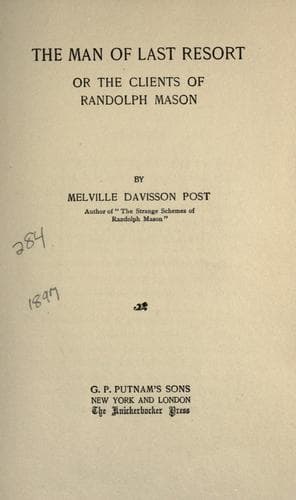
The Man of Last Resort; Or, The Clients of Randolph MasonPost, Melville Davisson
General
The Man of Last Resort; Or, The Clients of Randolph Mason
Post, Melville Davisson
American fiction -- 19th century; Detective and mystery stories, American; Legal stories, American
The detective explained further that being advised that Robert Gilmore
intended to leave Philadelphia for St. Louis, and fearing that it was
an attempt on the part of the president of the Octagon Coal Company
to escape from the country, he had hurried to McDowell and secured an
indictment.
Upon cross-examination it at once appeared that this detective had no
knowledge of any fact whatever, but was merely speaking from certain
conclusions which he was pleased to call his theory. The attorney for
the defense moved to strike out the evidence of this witness, which was
accordingly done, much to the chagrin of John Bartlett, detective, and
Salathiel Jenkins, deputy-in-extraordinary to the sheriff of McDowell.
The prosecuting attorney then proceeded to spring his sensation.
He announced to the court that during the night Gilmore had made a
confession to Mr. Jenkins, the deputy, and that he desired to have
Mr. Jenkins sworn and his testimony introduced. Accordingly the
irrepressible Jenkins, by virtue of an oath properly administered, was
transformed into a witness for the State of West Virginia.
Before the witness was permitted to launch into his marvellous story of
the self-condemnation of Robert Gilmore, the attorney for the defense
arose and demanded permission to inquire into the circumstances under
which the alleged confession had been obtained. The judge replied that
such inquiry was entirely proper, and the attorney for the defense
began.
The ways of Providence are without premonition. At the first onslaught
of the attorney for Gilmore, the importance of the testimony of
Salathiel Jenkins vanished like a New Year's resolution. Yes, he had
gone to the prisoner together with John Bartlett; he had explained
that he was the deputy sheriff of the county of McDowell; that he was a
person of influence; that the prisoner was in grave peril; and that, if
a full confession were made, he, Jenkins, would induce the authorities
of the law to deal leniently with the prisoner. He was a person of
importance, he said, and, in the absence of the sheriff, the first
guardian of all the law and order in the county of McDowell; if the
prisoner would confess, he, Salathiel Jenkins, could save him from the
hangman, and he would do it.
These were the conditions under which the alleged confession was made.
At this point in his narrative, the attorney for the prisoner stopped
the witness, and objected to the introduction of the confession as
having been improperly obtained. The court very promptly sustained the
objection, and directed the witness to stand aside.
The prosecuting attorney arose and asked the court to _nolle_ the
indictment and permit the case to be dismissed. The judge reminded him
that the case was at trial, and that such action could not now be taken;
that the request should have been made before a jury was called; it was
now too late, since the control of the cause had passed from the hands
of the State.
Public-domain text, read in full here on John Shaqi.
Reviews
Reviews
No reviews yet
Be the first to share your thoughts on this work.
Elsewhere in the archive
Join the Discussion
Join the discussion
Sign in to leave a comment or review.
Sign InorCreate an account