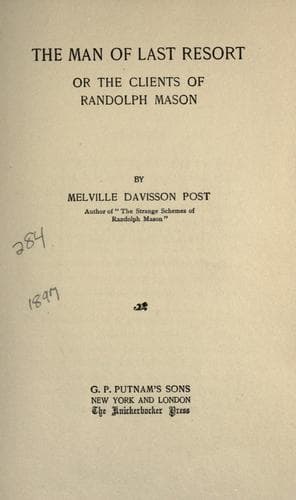
The Man of Last Resort; Or, The Clients of Randolph MasonPost, Melville Davisson
General
The Man of Last Resort; Or, The Clients of Randolph Mason
Post, Melville Davisson
American fiction -- 19th century; Detective and mystery stories, American; Legal stories, American
Whereupon a jury was had and the case ordered to proceed. The opening
statement of the prosecuting attorney was frank. It gave the history of
the case as he had heard it from Bartlett, admitting freely that he
had been unable to investigate the matter personally, but upon his
information he was convinced that the prisoner was guilty.
To this the counsel for Gilmore replied that the State was laboring
under a stupendous delusion; that Mr. Gilmore was a gentleman of
standing, and that it would quickly appear that there was no cause for
subjecting his client to the odium of a criminal prosecution.
The spectators were not a little disgusted with the tame proceedings.
They had expected a keen and spirited struggle with the startling
thrusts and parries of a bitter legal affair. They had hoped to hear the
steel grate, and to see the blades dart forward and bend and fly back,
as the champion of the State and its enemy strove for some master
vantage. They hoped for the fierce interests and the quick sharp thrills
incident to the grim fight of a desperate criminal for his liberty and
his life, and they were disgusted.
Their strong pugnacious spirit sympathized with Gilmore and damned his
counsel. In the picturesque speech of an auditor from “Dog Skin,” “The
lawyer was a quitter.”
The case progressed with almost exasperating insipidity.
The prosecuting attorney proceeded with great deliberation, and with the
air of one who maintains a thunderbolt in reserve. He proved the death
of Brown Hirst by the coroner and others; he introduced the books of the
company showing its financial standing; and put in such other matters of
unimportant evidence as were easily at hand. To all this the counsel for
Gilmore made no objection. To the observer, he was stupidly indifferent.
The prosecuting attorney then placed the detective John Bartlett on the
stand. Bartlett explained with great volubility that he was a member of
Latency's Detective Agency; that he had learned of the mysterious death
of Brown Hirst, and hoping to obtain the reward offered by Hirst's
widow, had gone to her and requested permission to investigate the case.
He explained that he had learned that the Octagon Coal Company was in
desperate financial straits; that the president, Robert Gilmore, who
resided in the city of Philadelphia, had been in the county of McDowell
on the night of Hirst's death, and from these data he had formulated his
theory to the effect that Gilmore had been stealing from the company;
that this fact had been discovered by Hirst, and that they had come
together in McDowell for the purpose of discussing this matter; that
there the two men had quarrelled, and the result was that Hirst had been
killed and his body thrown into the river, and the evidence of suicide
manufactured by Robert Gilmore.
Public-domain text, read in full here on John Shaqi.
Reviews
Reviews
No reviews yet
Be the first to share your thoughts on this work.
Elsewhere in the archive
Join the Discussion
Join the discussion
Sign in to leave a comment or review.
Sign InorCreate an account