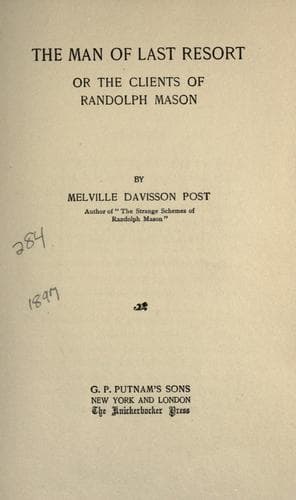
The Man of Last Resort; Or, The Clients of Randolph MasonPost, Melville Davisson
General
The Man of Last Resort; Or, The Clients of Randolph Mason
Post, Melville Davisson
American fiction -- 19th century; Detective and mystery stories, American; Legal stories, American
ON the night of the seventeenth day of July the judge of the criminal
court of McDowell walked into the office of the sheriff. He was in no
altruistic mood, this jurist. Since his fortunate political affiliations
had thrust him into a high estate his dignity sat upon him heavy as a
fog. He had been sent for. It was thoughtlessness approaching near to
disrespect. When the tall jurist entered, the crowd in the office of
White Carter arose.
“Judge,” drawled the sheriff, coming forward, “you must pardon the
centurion for taking this liberty with the tribune, but we were holding
a secret war council, and presently required the fountain of law. I am
sure you won't mind, Judge.”
The fountain of law flung aside his injured feeling with a wave of his
slim hand.
“It is all right, Carter,” he observed. “But why the conclave? Good men
should be abed.”
“'Day unto day uttereth speech,'” drawled the sheriff, “and night unto
night showeth knowledge. And just here the hurt lies. The boys have been
crowding the day and shirking the night turn.”
Then he stepped back by his companions and added: “Young Mr. Huron we
will overlook as familiar in your honor's forum. The other gentleman is
Mr. Hartmyer Belfast, in the secret service of the New York life
insurance companies.”
The judge nodded cordially and sat down by the table. The others also
resumed their seats, while the sheriff removed his eye-glasses, placed
them carefully on the forefinger of his fat right hand, and began to
explain.
“While I was absent, I believe, one Robert Gilmore was indicted here and
tried for murder, which trial resulted in a verdict of not guilty, the
evidence being insufficient to sustain the charge. It now appears
that Gilmore did kill Hirst, and that he can now be convicted with the
evidence in the possession of Mr. Belfast and myself.”
The judge elevated his eyebrows, but volunteered no comment.
The sheriff continued. “At the time of Hirst's death I was not quite
certain that it was suicide. The coat and vest found on the bridge did
not correspond to the trousers and shoes of the deceased, which were the
ordinary rough articles worn by the miners. There was no explanation for
such dress on the part of Hirst. Later I found a miner's coat at Jim's
Ford which corresponded to the other clothing of Hirst. This coat had
been tied in a bundle and thrown into the river above--probably at the
bridge. Stitched in the lining was a pocket book belonging to Brown
Hirst containing some money and a draft on New York, together with a
memorandum of a number of life insurance policies. These matters led me
to believe that Hirst had planned to secure the insurance on his life by
arranging a counterfeit suicide, but by some means the plan had failed
after the evidence had been prepared and he had come to a violent death,
probably by the hand of another.
Public-domain text, read in full here on John Shaqi.
Reviews
Reviews
No reviews yet
Be the first to share your thoughts on this work.
Elsewhere in the archive
Join the Discussion
Join the discussion
Sign in to leave a comment or review.
Sign InorCreate an account