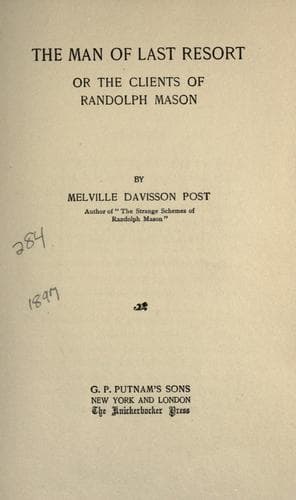
The Man of Last Resort; Or, The Clients of Randolph MasonPost, Melville Davisson
General
The Man of Last Resort; Or, The Clients of Randolph Mason
Post, Melville Davisson
American fiction -- 19th century; Detective and mystery stories, American; Legal stories, American
“But the matter was involved in mystery, and I deemed it best to retain
my conclusions until further developments should appear. I wrote to the
various companies with which Hirst was insured, explaining the facts
which I had determined. They replied that the matter was in the hands of
Hartmyer Belfast, their secret agent, and that I would be advised when
the investigation was complete.
“A few days since the companies wired me that Mr. Belfast might be
expected to appear in my county at any time, and yesterday he called
upon me.”
The sheriff moved a little closer to the table, and the drawl seemed to
slip out of his speech.
“It can now be shown that Robert Gilmore came to McDowell for the
purpose of assisting Hirst to manufacture evidence of a suicide; that he
went with him upon the bridge, and after enticing Hirst to the rail of
the bridge, suddenly threw him over into the river. The train men can
be produced who saw Gilmore when he arrived and when he departed on the
night of the murder. All of this evidence has been carefully prepared.
In addition, it can be shown that immediately after his trial, for some
mysterious reason Gilmore went directly to Philadelphia and arranged
for a conference with the widow of Brown Hirst. Of this Mr. Belfast had
notice, and, by request of Mrs. Hirst, he was present, concealed in
an adjoining room. This conference between Gilmore and Mrs. Hirst was
remarkable. The man was deeply affected, and said that he had come to
tell her the entire history of his villainy, because he loved her, had
loved her always, and now knew that he could never have her. Whereupon
he explained that Hirst and himself had planned to rob the insurance
companies; that Hirst's marriage to her was part of the scheme, but
that he, Gilmore, had grown to love her, and to regret his action in
procuring the marriage, and so frightfully had this grown upon him that
finally he had killed Hirst.
“He then explained the minute circumstances of the death, adding that he
had been tried and acquitted, and would now leave the country, but that
something in his bosom would not rest until he had told her the entire
truth. So we have now, I judge, a complete case, together with the
confession, which, I am told, will be quite proper evidence, and
with such a case there can now be nothing in the way of Gilmore's
conviction.”
“Nothing at all,” observed the judge, dryly, “except the Constitution of
the United States of America.”
The sheriff sat down suddenly and replaced the eye-glasses on his fat
nose.
“You mean,” said the prosecuting attorney, “that the prisoner cannot be
put twice in jeopardy for the same offense?”
Public-domain text, read in full here on John Shaqi.
Reviews
Reviews
No reviews yet
Be the first to share your thoughts on this work.
Elsewhere in the archive
Join the Discussion
Join the discussion
Sign in to leave a comment or review.
Sign InorCreate an account