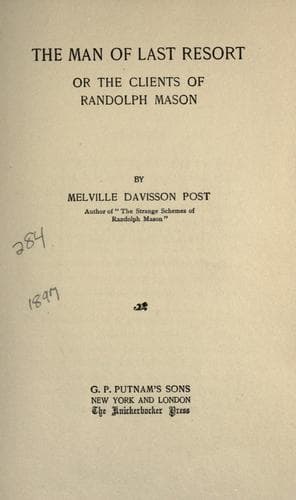
The Man of Last Resort; Or, The Clients of Randolph MasonPost, Melville Davisson
General
The Man of Last Resort; Or, The Clients of Randolph Mason
Post, Melville Davisson
American fiction -- 19th century; Detective and mystery stories, American; Legal stories, American
“Unless,” responded the judge, “the judicial machinery in McDowell can
be held exempt from the Constitution of the State and the Constitution
of the Federal Government, a conclusion,” he added, with prodigious
gravity, “in which I should rather hesitate to concur upon a casual
hearing. Having been once properly tried for murder, this man cannot be
again tried for the same offense.”
“It has been held,” said the prosecuting attorney, “that where the first
trial was procured by the fraud of the prisoner, the case did not come
within the provisions of the Constitution.”
“True,” replied the judge, “there is an early case in Virginia, and
later cases of record, but the fraud must be gross and apparent. What
fraud could be shown here? The indictment was properly found, the trial
was regular, no suspicion of conspiracy attaches to the officers of the
State, nor can it be shown that even misstatements were made, unless
a plain conspiracy can be shown on the part of this detective, John
Bartlett.” Then he turned to the secret agent of the life insurance
companies. “How about this Bartlett?” he asked.
“So far as I can learn,” replied the detective, “Bartlett made no false
statements. He is a member of Loomey's Agency in New York. It is true
that he called on Mrs. Hirst and requested permission to investigate the
case. What he stated to the prosecuting attorney as facts were facts.
Of course, his theory was wrong, and his deductions incorrect; but for
these, I presume, he could not be held responsible. I have investigated
the matter with care, and while it is extremely probable that this trial
was shrewdly procured by Gilmore, yet it has been so skilfully handled
that no fraudulent proceeding could be shown on the part of Bartlett,
although I am quite certain of his villainy.”
The sheriff rubbed his hands with the bland unction of a Hebrew at a
“fire sale.”
“Jeb,” he drawled, “I guess you're it. I guess the thing is all over but
the shouting.”
“Well,” responded the prosecutor, “I judge there are others. How about
the lamented Jenkins, erstwhile representative of the sheriff of
McDowell? Is the young man Absalom safe?”
A faint ripple of merriment spread over the fat face of the sheriff.
“Boys,” he mused, “it was a keen flim-flam. Let us quietly disperse, and
endeavor to live it down.” Then he added wearily. “It may be good to be
good, but it is safer to be smooth.”
The judge arose. “Mr. Gilmore has been tried and acquitted,” he
observed. “The record is complete. He cannot be held again to answer
for this crime, even though he be pleased to proclaim his guilt from the
housetops.”
“Then,” said the detective, with the dreary deliberation of one retiring
from a failing cause, “this murderer cannot be punished.”
The dreamy blue eyes of White Carter swam listlessly
“Perhaps,” he drawled, “when the gentleman shall have passed the
melancholy flood with that grim ferryman whom poets write of unto the
Kingdom of Perpetual Night.”
Public-domain text, read in full here on John Shaqi.
Reviews
Reviews
No reviews yet
Be the first to share your thoughts on this work.
Elsewhere in the archive
Join the Discussion
Join the discussion
Sign in to leave a comment or review.
Sign InorCreate an account