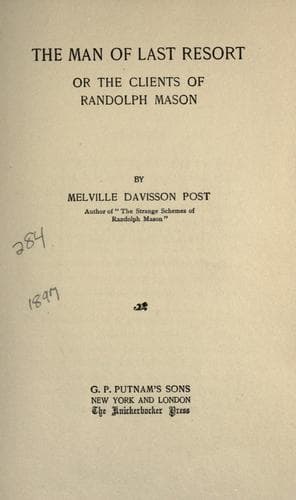
The Man of Last Resort; Or, The Clients of Randolph MasonPost, Melville Davisson
General
The Man of Last Resort; Or, The Clients of Randolph Mason
Post, Melville Davisson
American fiction -- 19th century; Detective and mystery stories, American; Legal stories, American
Rufus Alshire was a grazier, a business almost exclusively followed in
this magnificent grass country. Many years before, his greatgrandfather,
an English Tory, had fled into this inland country in order to escape
certain unpleasant relations with the colonial government. Here he had
builded an enormous log manor-house, and surrounding himself with rather
worthless retainers, maintained a sort of baronial existence. Others
followed, and after a time the country was cleared and came to be
divided into great tracts of pasture land, owned by these powerful
families. But the elements of the feudal system, although suffering some
modifications, remained. The tenants were, for the most part, born and
reared on the stock land, and were almost fixtures.
The descendants of this independent ancestry continued to reside as near
to the central part of their estate as possible, and maintained huge
residences, rough at times and not quite comfortable perhaps, but always
enormous. The nature of the country being especially adapted to the
fattening of beef cattle, this industry soon came to be the exclusive
business of this powerful people. It was a profitable and supremely
independent industry, and gave wide play to the baronial instincts of
the Anglo-Saxon; who, even after the golden time of his race had gone
out so many hundred years, still loved the open sky, and the blue hills,
and the monster oak trees, and hated in his heart with a stubborn bitter
spirit of rebellion the least shadow of restraint. He was willing to
serve God if need be, but while he lived he would not serve men. In
stature the descendants of the long dead Saxon were huge specimens
of the race, almost as big of limb as the fabled barbarians of Lygia;
powerful men, whom close and intimate relations with the mother nature
kept strong and immensely vital to the very evening of life. But withal
the hospitality of the Saxon was profligate, his impulses were kindly,
and he was quite content to leave the affairs of government and the
problems of civilization to other hands, provided the minions of these
powers held their feet back from his soil.
The twilight had deepened into night; on the crest of the far-off hills
the great oak trees stood outlined against the sky like mighty silent
figures waiting for some mystic word that should call them into life.
The rim of the moon was rising slowly from behind the oil field, red
like battered brass; the road, covered with shifting light and shadow,
stretched across the rolling country like a silver ribbon. The grazier
rode slowly, his hands hanging idly at his sides, and his face set with
deep thought; from time to time he raised his ponderous right hand and
struck it heavily against the tree of his saddle as though to indicate
thereby some important decision finally reached, but as often he dropped
the hand back to its place.
Public-domain text, read in full here on John Shaqi.
Reviews
Reviews
No reviews yet
Be the first to share your thoughts on this work.
Elsewhere in the archive
Join the Discussion
Join the discussion
Sign in to leave a comment or review.
Sign InorCreate an account