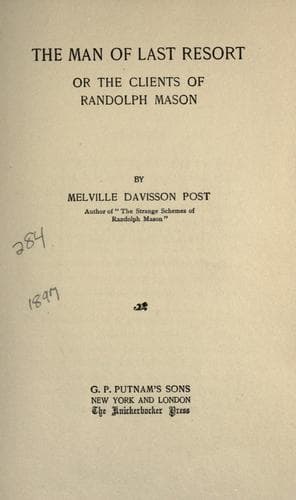
The Man of Last Resort; Or, The Clients of Randolph MasonPost, Melville Davisson
General
The Man of Last Resort; Or, The Clients of Randolph Mason
Post, Melville Davisson
American fiction -- 19th century; Detective and mystery stories, American; Legal stories, American
The important information of the oil driller had added a mighty element
to the matters with which he was evidently concerned. The horse, left to
his own inclinations, quickened his pace and presently the shadow of a
huge house loomed upon the crest of the hill at the roadside. The horse
stopped at the gate, and the man. aroused from his reverie, dismounted
slowly, and opening the gate led the horse through; as he closed the
gate he stopped for a moment and rested his enormous elbow on the
latch. “Well,” he said, as though announcing his temporary conclusion to
himself, “I'll ship the cattle to-morrow, and I'll see Jerry.”
II
FROM the earliest record of events, either sacred or profane, the genus
Bos has been associated with the history of the landowner. The Ancient
Egyptian saw in him certain traces of divinity, and honored it with
proper recognition. The lamented Job, erstwhile poet of calamity,
found time amid the recording of his numerous disasters to set down
his venerable appreciation of the species; and the pagan Homer, while
singing of gods and men, remembered to sing also the virtues of the
noble bullock; and the painters, too, from Claude Lorraine to Rosa
Bonheur, have deigned to consider the artistic importance of the
domesticated kine; treating him first as a necessary adjunct to a
landscape, and later as a central figure in the scene. He has had his
part, say the records, not infrequently with the plans of men, virtuous
and otherwise. A certain wily barbaric general used him well in a
difficult emergency, and the patriarch Jacob used him in a shrewd
physiological experiment, which he had probably learned at Padan-aram
in his salad days; an experiment that added much to the worldly worth of
the good father, but detracted not a little from his fame.
When the sun climbed up from behind the broad eastern hillside on the
following morning it looked down upon Rufus Alshire, who, far more
expeditious than itself, had already set himself to the affairs of the
day; before the dawn he had brought the cattle from their beds in the
cool pasture land, weighed them at his scales and turned them out in the
road on their journey to the shipping station some ten miles away. The
herd strayed leisurely along the highway. The giant Alshire rode through
the drove, keeping the bullocks moving slowly; while following the herd
barefoot in the dust, was one of his retainers, a half-witted youth,
wearing an ancient straw hat, a shirt originally of the material called
“hickory,” but now patched in variegated colors, and blue cloth trousers
well worn and frayed. As the youth tramped along he sang in a high
piping voice one of those simple little songs which the playing children
sing, and by way of illustration danced up and down and whipped the dust
with a long hickory switch. On his heart was no shadow of the cares of
men, and for this reason, perhaps, under his torn shirt was two-thirds
of the happiness of the world.
Public-domain text, read in full here on John Shaqi.
Reviews
Reviews
No reviews yet
Be the first to share your thoughts on this work.
Elsewhere in the archive
Join the Discussion
Join the discussion
Sign in to leave a comment or review.
Sign InorCreate an account