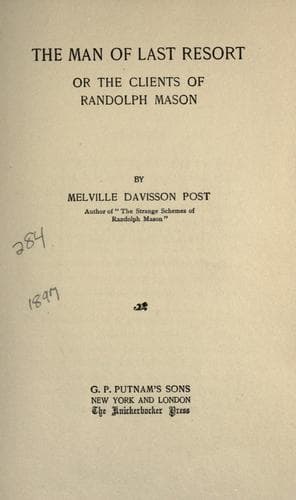
The Man of Last Resort; Or, The Clients of Randolph MasonPost, Melville Davisson
General
The Man of Last Resort; Or, The Clients of Randolph Mason
Post, Melville Davisson
American fiction -- 19th century; Detective and mystery stories, American; Legal stories, American
When the stockholders of the Massachusetts Iron Company finally demanded
a reorganization, he had employed the best legal talent and thrust in
every delay of the law. The fight had gone on year after year, from
court to court. Orders had been entered and dissolved; decrees had been
made and reversed; hearings had been granted by superior courts, and
rehearings, but the end, long delayed, came finally.
The stockholders had applied for a rule. It was the most summary
proceeding known to the law. To-morrow he must pay the money, or go to
prison a felon. The end loomed like the ragged outlines of a cliff.
To Carper this end seemed atrociously unjust. He had worked so hard, so
hard: the best that was in him; the good days of his life had been given
up to this labor It had been his boyhood dream to be a factor in great
affairs,--the bitter labor of his youth, and, in part, the realization
of his middle life. He had cut every other thing away with a hand that
never once had trembled. It was his right to win, if there was any
justice anywhere. But to-morrow was the end. To-morrow the court would
strip him naked as a bone.
He had heard many a sleek pastor discourse glibly upon the eternal
justice of Providence. Then he believed it cant with a smattering of
truth. Now it was entirely clear that it was cant--but false; a pleasant
lie like the housewife tale of fairies.
Carper took the cigar from between his teeth and dropped it on the
hearth. The game of life was an ugly game. He confessed that he had lost
interest in its play. Now that the thought suggested he saw that he had
been losing interest all along. It was inertia he had been fighting--the
plague of inertia, and for no gain at all. It was a world where, if one
sat still, one wasted with monotony; and if one labored, it was only for
the purpose of building ships to fly in the air, which, when they were
all completed, sat stupidly on the earth or by hap toppled heavily upon
the builder, crushing out his heart. He could not understand why men had
sometimes said that life was good.
Carper had looked, he believed, into not a few chambers of the temple.
The same hooded shape sat in each. If fame was given, the skull was
pretty generally crushed with the crown. If wealth was given, the back
was broken with the weight. If love was given,--yes, the heart was
usually broken with it,--love!
Carper arose and went over to a cabinet in the wall, unlocked the door
and took out a big photograph, which he brought over to the fire. It was
the picture of a woman, young, beautiful, quivering with the power of
life; the mass of dark hair was caught back from her forehead; the eyes
were wide, clear, transparent; the nose was straight as the edges of a
die, and the throat round, full, marvellously moulded. In the set of the
head there was pride of lineage, and the relentless rigor of purity.
It was a fine face looking out from a blameless life, strong, innocent,
exacting as a child.
Public-domain text, read in full here on John Shaqi.
Reviews
Reviews
No reviews yet
Be the first to share your thoughts on this work.
Elsewhere in the archive
Join the Discussion
Join the discussion
Sign in to leave a comment or review.
Sign InorCreate an account